Key takeaways
- Frosted window film is a translucent matte PVC film that scatters light, blurring views through glass while letting most daylight through.
- Unlike reflective one-way film, frosted film provides privacy both day and night because it diffuses light equally in both directions.
- Decorative frosted glass film is typically 0.10 to 0.16 mm thick and lasts around 3 to 5 years indoors.
- The wet application method with a soapy slip solution lets you position frosted film and squeegee out bubbles.
- Film is the only reversible way to frost glass; etching cream, sandblasting and replacement obscure glass are permanent.
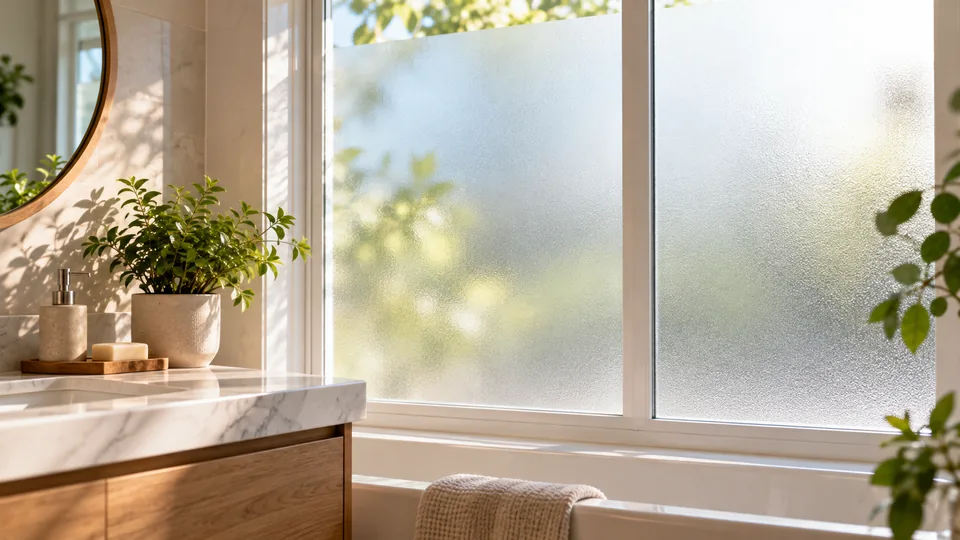
Frosted window film is a translucent, matte PVC film that you apply to the inside of a window or glass door to make clear glass look like frosted glass. It blurs shapes and blocks direct views while letting most daylight through, works day and night, and costs far less than replacing the glass. Most versions peel off cleanly later.
Whether you want privacy for a bathroom window, a frosted glass interior door or an office meeting room, film is usually the fastest way to get the look. This guide explains how frosted glass film compares with real etched and obscure glass, which type to choose, how to install it without bubbles, and what to check when buying rolls for commercial projects.
What is frosted glass, and how does film imitate it?
Frosted glass is glass whose surface has been roughened so it scatters light instead of letting it pass straight through. The result is translucent, not transparent: you see light and color, but not detail. Real frosted glass is made in three main ways:
- Acid etching: hydrofluoric acid dissolves a thin layer of the surface for a smooth, satin, "milky" finish.
- Sandblasting: abrasive grit is blasted onto the glass, giving a slightly rougher white frost. Designs are created with stencil masks; see our guide to glass etching with stencil film.
- Patterned or obscure glass: a texture is rolled into the glass while it is molten, as in reeded, fluted or "fuzzy glass" bathroom windows.
Frosted window film reproduces the etched look with a micro-textured or matte-coated PVC face. Light hits the uneven surface, scatters and diffuses, so the glass appears lightly frosted to opaque depending on the grade. A typical construction is a 0.10–0.16 mm (4–6 mil) PVC face, a pressure-sensitive adhesive and a release liner.
Frosted glass film vs real frosted glass and other methods
There are several ways to frost windows for privacy. They differ mainly in cost, permanence and how professional the result looks.
| Method | Permanence | Look | Typical cost | DIY? |
|---|---|---|---|---|
| Adhesive frosted window film | Semi-permanent; removable | Very close to etched glass | Low | Yes |
| Frosted static cling window film | Temporary; reusable | Good; can show edges | Low | Yes, easiest |
| Frosted contact paper | Temporary | Flat, sometimes plasticky | Lowest | Yes |
| Frosting spray | Semi-permanent | Can be uneven; scratches easily | Low | Yes, but tricky |
| Etching cream | Permanent | Real etched glass, small areas | Low to medium | Yes, small panes |
| Sandblasting or acid etching | Permanent | Real frosted glass | High | No, professional |
| Obscure or frosted replacement glass | Permanent | Real frosted glass | Highest | No |
For most homes and offices, adhesive frosted vinyl window film is the best balance. It looks close to real etched glass, lasts years indoors, and can be removed if you move or change your mind.
Types of frosted window film
Adhesive vs static cling frosted film
Adhesive frosted film uses a pressure-sensitive adhesive and is applied wet so it can be positioned. It bonds firmly, resists edge lifting in humid rooms and is the standard for commercial window frosting. Frosted static cling window film has no adhesive; it holds by surface tension and static, which makes it reusable and ideal for renters, but it can peel at the edges over time. Our comparison of static cling vs adhesive window film goes into the trade-offs.
Plain, patterned and decorative frosted film
- Plain white frosted window film: uniform etched glass film, the most popular choice for bathrooms and offices.
- Decorative frosted glass window film: stripes, squares, geometric shapes or florals cut into the frost so some clear areas remain.
- Gradient frosted glass film: fades from opaque at the bottom to clear at the top, keeping views out of a window while hiding the lower half.
- Coloured or black frosted glass film: tinted frost for design accents and branding.
- Custom frosted window film: logos, frosted window graphics and frosted glass designs for doors, plotter-cut from frosted vinyl.
A related product, frosted reflective window film, combines a frosted area with a mirrored or tinted heat-control layer. Window film that turns opaque on demand is a different technology (switchable smart glass film) and needs electrical power.
Where should you use frosted window film?
- Bathroom windows: frosted windows in a bathroom are the classic use. Frosted bathroom window film keeps privacy while preserving daylight, and it is an alternative to frosted bathroom window replacement.
- Shower screens and frosted window in shower: apply film to the dry side of the glass only and seal edges; water running over the film edge will eventually lift it.
- Interior doors: inside doors with frosted glass, frosted interior French doors, frosted closet doors and frosted glass bedroom doors.
- Front doors and sidelights: privacy without blocking light in hallways, often with a gradient or border design.
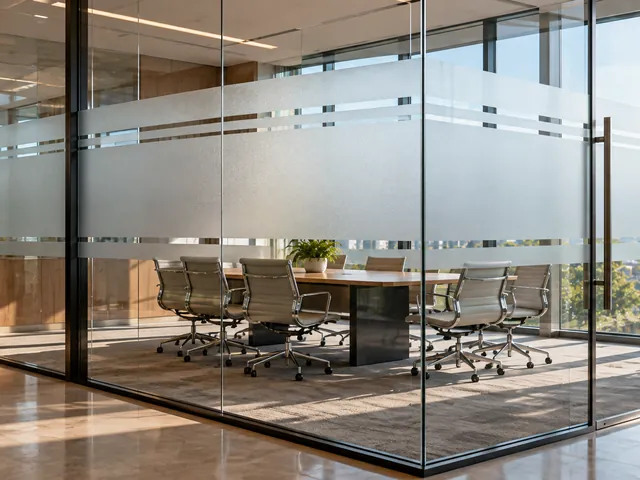
- Offices: frosted glass office doors, conference room frosted glass, manifestation bands for safety marking, and frosted glass meeting room partitions. Our office glass project shows a typical installation.
- Cabinets and furniture: frosted panels for glass cabinet doors and display units.
Does frosted window film give privacy at night?
Yes, and this is its main advantage over reflective one-way film. Reflective mirror film only works when the outside is brighter than the inside; at night, with lights on indoors, people can see in. Frosted film diffuses light equally in both directions, so it hides detail day and night.
One caveat: with a bright light behind someone standing very close to the glass, a soft shadow outline may show through lightly frosted film. If you need full opacity, choose a denser white matte glass film or an opaque window glass film. For a full breakdown of day and night options, see our privacy window film guide.
How do you install frosted window film?
Installing window frosting film uses the wet method, which lets you slide the film into place and squeeze out bubbles. Work at 10–30 °C (50–86 °F), out of direct sun.
- Clean the glass thoroughly. Scrape off paint specks with a blade, wash with soapy water, and wipe the frame edges so no grit gets under the film.
- Measure and cut. Measure the visible glass and cut the film about 2–3 cm (1 in) larger in each direction.
- Mix a slip solution. Fill a spray bottle with water and a few drops of mild baby shampoo or dish soap.
- Spray the glass generously. The whole pane should be wet.
- Peel the liner and spray the adhesive side. Wet fingers prevent fingerprints on the adhesive.
- Position the film. Lay it on the glass and slide it into place, leaving the overlap at the edges.
- Squeegee from the center outward. Use firm, overlapping strokes to push water and air to the edges.
- Trim the edges. Use a sharp blade against a straightedge, leaving a 1–2 mm (1/16 in) gap at the frame so the edge does not lift.
- Final squeegee and cure. Squeegee again, wipe dry, and leave the film to cure; small haze or water pockets usually disappear within a few days to two weeks.
Full detail, including removal, is in our guide on how to install and remove window film without bubbles.
How can you frost glass without film?
If you want to know how to frost glass permanently, the DIY options are frosting spray and etching cream. Frosting spray gives a quick, even mist if applied in several light coats, but it scratches and can look blotchy. Etching cream chemically etches the glass and is permanent, though it suits small panes and stencil designs better than whole windows, and it must not be used on tempered or coated glass without checking first. For large areas, professional sandblasting or replacement obscure glass gives the most durable result.
Clear glass to frosted glass with film remains the only reversible option, which is why it is the default for renters and offices that may change layout.
How do you clean and care for frosted glass film?
Wait about 30 days after installation before cleaning the film, so the adhesive can fully cure and any remaining moisture can evaporate. After that, frosted film is easy to look after:
- Use a soft cloth or microfiber with mild soapy water or an ammonia-free glass cleaner. Ammonia and solvents can cloud or weaken some films.
- Avoid abrasive pads, scrapers and razor blades on the film surface; they leave clear scratches in the matte finish.
- Wipe, do not scrub, the edges, and press down any edge that starts to lift before dirt gets underneath.
- Remove fingerprints promptly on frosted glass doors, because oils can darken the matte surface temporarily.
Handled this way, the film keeps an even, etched appearance for years, and a single damaged pane can be re-filmed without touching the others.
How to choose frosted window film for a project
For retailers, glaziers, sign shops and interior contractors, compare these specifications:
- Thickness: 0.10–0.16 mm (4–6 mil) for most decorative frosted film; thicker film handles easier and resists tearing.
- Opacity: lightly frosted, standard etched or opaque white.
- Adhesive: permanent for commercial jobs, removable or static cling for residential and rentals.
- Roll width: wide rolls avoid seams on large panes and partitions.
- Safety function: some films hold glass fragments together if the pane breaks.
- Indoor durability: typically 3–5 years for decorative PVC glass film.
Our white frosted etched privacy glass film is supplied in 0.14 or 0.16 mm thicknesses, on 0.61 × 50 m and 1.22 × 50 m rolls, with an explosion-proof function and an indoor life of 3–5 years. Patterned and striped versions are available in widths up to 1.52 m.
Next step
Send us the glass sizes, the frost style or pattern you need, and the quantity of rolls, and we will reply with a quotation within 24 hours. Contact us for free A4 samples so you can check opacity on your own glass.
Frequently Asked Questions
Does frosted window film let light in?
Yes. Frosted window film is translucent, so it lets most daylight through while scattering it, which blurs shapes and blocks clear views. Lightly frosted grades keep rooms brighter, while denser white or opaque films transmit less light but give stronger privacy. Rooms with frosted film usually feel softly lit rather than dark.
Can people see through frosted window film at night?
No, frosted window film hides detail at night as well as during the day, because it diffuses light equally in both directions. Unlike mirror film, it does not depend on outdoor light levels. With bright light behind someone standing close to the glass, a soft shadow outline may show through lightly frosted grades.
How do you make clear glass frosted?
The easiest way to make clear glass frosted is to apply adhesive or static cling frosted window film using the wet method. Other options are frosting spray, etching cream for small panes, professional sandblasting or acid etching, or replacing the pane with obscure glass. Film is the only method that can be removed later.
Is frosted window film removable?
Most frosted window film is removable. Static cling film peels off and can be reused. Adhesive frosted film can be removed by lifting a corner and peeling slowly, using a little heat from a hairdryer if needed, then cleaning any adhesive residue off the glass with soapy water and a plastic scraper.
Can you put frosted film on a shower door?
You can apply frosted film to a shower screen or shower door, but only on the dry side of the glass. Water running constantly over the film edge on the wet side will lift it over time. Seal or trim the edges neatly, and choose a waterproof adhesive grade designed for bathrooms.
How long does frosted window film last?
Indoor decorative frosted window film typically lasts 3 to 5 years, and often longer on interior doors and partitions that see no direct sun. Lifespan depends on the film grade, sunlight exposure, humidity and how the glass is cleaned. Use soft cloths and non-abrasive, ammonia-free cleaners to keep the film looking even.
Is frosted film better than frosting spray?
For most windows, frosted film is better than frosting spray. Film gives a uniform, professional etched look, resists scratches better and can be removed cleanly. Frosting spray is quick for small decorative projects but often looks uneven on large panes, scratches easily and is harder to remove from glass.