Key takeaways
- Contact paper is usually 60–100 micron PVC, while vinyl cabinet wrap is typically 120–500 micron and embossed or top-coated.
- On daily-use kitchen doors, vinyl wrap typically lasts two to three times as long as standard contact paper.
- Wrapping film at least 1–2 cm around to the back of each door is the single biggest factor in preventing lifting edges.
- Grease is the main cause of cabinet wrap failure, so doors must be degreased and wiped with isopropyl alcohol before application.
- A 1.22 m × 50 m roll of furniture film covers about 61 m² (roughly 650 sq ft) before waste.
Contact paper for cabinets is a thin, low-cost self-adhesive film that suits light-use or temporary makeovers, while vinyl cabinet wrap is a thicker, more conformable PVC film that wraps edges and typically lasts several years on daily-use kitchen doors. If you want a durable kitchen refresh, choose vinyl wrap; for shelves, rentals or quick updates, contact paper is fine.
Both products are peel-and-stick, and they are often sold under the same names: kitchen cabinet covers, cabinet covering, peel and stick for cabinets, kitchen wrap or, in the UK, kitchen cupboard vinyl wrap and kitchen cupboard contact paper. That overlap is why the difference confuses people. This guide compares them on thickness, durability, finish, cost and installation, and explains what to look for whatever you call the product on the label.
What is the difference between contact paper and vinyl cabinet wrap?
Both are a layer of decorative PVC film, a pressure-sensitive adhesive (PSA) and a release liner. The differences are in the gauge of the film, the adhesive and the surface:
- Contact paper is usually 60–100 micron (about 2.5–4 mil) PVC with a paper liner and a general-purpose adhesive. It is sold in narrow rolls for shelves, drawers, crafts and light furniture.
- Vinyl cabinet wrap (also called cabinet wrap film or furniture film) is typically 120–500 micron (about 5–20 mil). Thicker grades are embossed to imitate wood grain or stone, have scratch-resistant top coats, and use an adhesive designed for long-term bonding to laminate, painted MDF and lacquer.
The thickness matters more than anything else. Thicker film hides small dents and old grain, resists knife and shoe scuffs, and can be stretched around a door edge with gentle heat without tearing. Our home and furniture decorative films are 0.5 mm (500 micron) PVC on 1.22 m × 50 m rolls with a 3-year warranty, which is the heavy end of this range.
Contact paper for cabinets vs vinyl wrap: comparison table
| Feature | Contact paper | Vinyl cabinet wrap |
|---|---|---|
| Typical thickness | 60–100 micron (2.5–4 mil) | 120–500 micron (5–20 mil) |
| Typical life on kitchen doors | About 1–2 years | About 3–7 years, depending on grade and use |
| Edge wrapping | Tears or lifts on tight edges | Stretches around edges with heat |
| Surface | Flat print, gloss or matte | Embossed wood grain, matte, high-gloss, pearlescent, stone |
| Hides imperfections | Poorly; shows grain and dents | Well, especially embossed grades |
| Heat and moisture | Edges lift near kettles and dishwashers | Better, but keep away from oven vents |
| Removal | Easy, sometimes leaves residue | Clean on sound surfaces when warmed |
| Best for | Shelves, drawers, rentals, temporary cabinet covers | Kitchen cabinet doors, islands, long-term refacing |
"Peel and stick laminate for cabinets" and "wood veneer laminate for cabinets" are different again. Real wood veneer is a thin slice of wood on a paper or fleece backing; high-pressure laminate is a rigid decorative sheet glued with contact cement. Both outlast film but need more skill and tools.
Which lasts longer on kitchen cabinets?
When you put vinyl wrap on kitchen cabinets and contact paper on cabinet doors side by side, vinyl wrap lasts longer, typically two to three times as long as standard contact paper on doors used every day. Kitchen cabinets are a hard environment: hands push the same corners hundreds of times a month, steam rises from kettles and dishwashers, and cleaning sprays soften weak adhesives.
Lifetime depends on four things more than on the product name:
- Film gauge. Thicker PVC resists abrasion and does not shrink back from edges as quickly.
- Edge treatment. Film wrapped at least 1–2 cm (about 0.5–0.75 in) around to the back of the door survives far longer than film trimmed flush at the front.
- Surface preparation. Grease is the main reason kitchen cabinet wraps fail. A degreaser plus isopropyl alcohol wipe is not optional.
- Location. Doors next to the oven, dishwasher or kettle see heat and steam. Some installers leave these doors painted or use a heat-resistant laminate.
What is the best contact paper for kitchen cabinets?
If you choose contact paper, the best contact paper for cabinets in a kitchen is the thickest, waterproof contact paper for cabinets you can find, with an embossed or textured surface and a gridded liner for accurate cutting. Look for:
- Thickness above 100 micron (4 mil); anything thinner shows every flaw.
- Waterproof, wipe-clean PVC face and an oil-proof rating near the stove.
- A repositionable adhesive for easier alignment on large doors.
- The right color. White contact paper for cabinets is the most popular choice and suits small kitchens; black contact paper for cabinets and matte finishes hide fingerprints better than high-gloss white; wood grain suits shaker doors.
High quality contact paper for cabinets overlaps with entry-level furniture film. Our pearlescent solid-color decorative film, for example, is 120 micron with a 75 g release paper, which sits right between the two categories.
What is the best vinyl wrap for kitchen cabinets?
The best vinyl wrap for kitchen cabinets, and the most durable kitchen cabinet cover you can apply yourself, is a 0.2–0.5 mm PVC film with an embossed or textured surface, a scratch-resistant top coat and a permanent-but-removable acrylic adhesive. Popular finishes for kitchen vinyl wrap:
- Wood cabinet vinyl wrap in oak, walnut or white-washed grain. An embossed grain is far more convincing than a flat print.
- Super-matte solid colors in sage, navy, charcoal or warm white for a modern painted look.
- High-gloss for handle-less contemporary kitchens. Gloss shows fingerprints and imperfections in the door, so preparation must be perfect.
- Marble or stone on islands and end panels rather than every door.
If you only want to protect existing cabinets, not change their color, a clear or matte protective film for cabinets is a different product: our matte anti-fingerprint protection film preserves the original finish rather than covering it.
Can you wrap kitchen cabinets yourself? How to do it
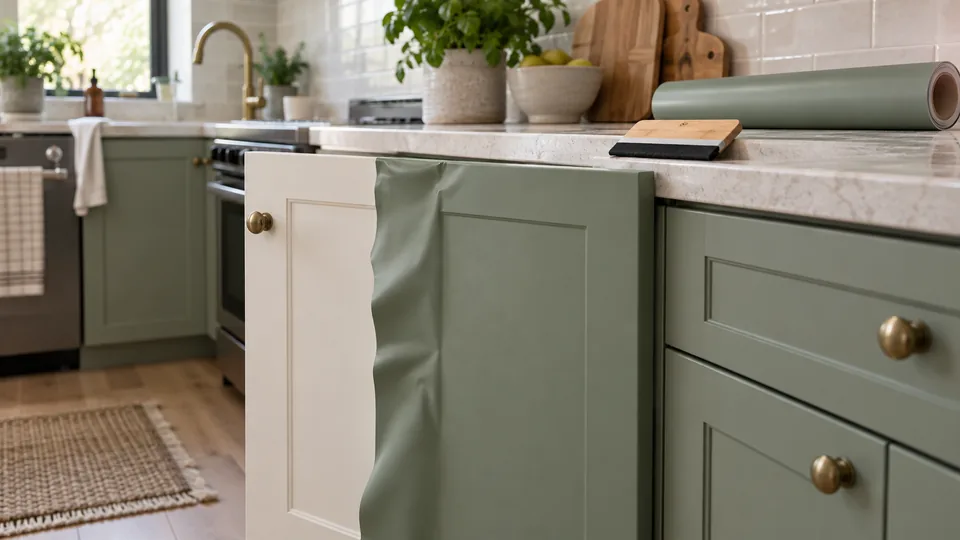
Yes, you can wrap kitchen cabinets yourself if the doors are flat or have simple shaker profiles. Deep raised-panel doors and ornate moldings are much harder; consider professional refacing for those. The DIY kitchen vinyl wrap installation process:
- Remove doors and drawer fronts. Take off hinges and handles and number each piece.
- Clean and degrease. Wash with a kitchen degreaser, rinse, dry, then wipe with isopropyl alcohol.
- Repair and scuff. Fill chips with wood filler, sand smooth and scuff glossy surfaces lightly with a fine abrasive pad so the adhesive can key.
- Cut the film oversized. Allow 3–5 cm (1–2 in) extra on every side for wrapping.
- Apply from one edge. Peel 10–15 cm of liner, align and squeegee in overlapping strokes from the center out, pulling the liner as you go.
- Wrap the edges. Warm the film with a heat gun or hairdryer to about 40–60 °C (104–140 °F), then stretch it over the edge and onto the back.
- Cut the corners. Make a relief cut at each corner, fold the film like wrapping a gift and trim the excess on the back.
- Post-heat and rehang. Warm edges once more to set the adhesive, then refit hinges through the film. Avoid wet cleaning for 24 hours.
For more detail on edges and corners, see how to wrap furniture with vinyl film.
How much does it cost to wrap kitchen cabinets?
Vinyl wrap cabinets cost far less than replacing or professionally painting them. For DIY, the film for an average kitchen of 15–25 doors and drawer fronts usually costs a small fraction of new doors; contact paper is cheaper again. Professional cabinet wrapping cost is mostly labor and varies widely by region, but in many markets it is still well below the cost of new doors or a full cabinet replacement.
To estimate film quantity, add up the door and drawer areas, add 3–5 cm per side for wrapping, then add about 15% for mistakes and grain matching. A 1.22 m × 50 m roll covers about 61 m² (roughly 650 sq ft) before waste, enough for several kitchens. For a broader cost comparison of the options, read cabinet refacing vs replacing vs wrapping.
Removable and temporary cabinet covers
Renters often want removable cabinet covers they can take off at move-out. Both contact paper and vinyl wrap peel off, but removal is clean only when the original surface is sound: factory laminate and thermofoil are safest; old, poorly bonded paint may lift with the film. Always test a hidden area for a week first, and remove film slowly at a sharp angle, warming it with a hairdryer.
The same products are used for other cabinet stickers and kitchen stickers: covering file cabinets (file cabinet contact paper), lining cupboard shelves, decorating kitchen cupboard doors with patterned decals, and kitchen stickers wall decor near breakfast nooks.
Where to buy vinyl wrap for kitchen cabinets
Homeowners usually buy contact paper and small rolls of cabinet wrap from big-box stores, online marketplaces and craft shops. Refacing businesses, installers and retailers buying in volume usually buy wide trade rolls directly from a manufacturer, which gives consistent color across batches and lower cost per square meter.
We supply 1.22 m × 50 m rolls of wood grain, solid matte, high-gloss, pearlescent and marble furniture film from 1 roll for stock items, and 100 rolls for custom colors or private-label packaging. See how one refacing business set up its program in our kitchen cabinet refacing case study.
Next step
Send us photos of the cabinet doors, the substrate (laminate, painted MDF, wood or thermofoil) and the finishes you like. We will send free A4 samples for an adhesion test and a quotation within 24 hours. Contact us for samples.
Frequently Asked Questions
Is contact paper on kitchen cabinets a good idea?
Contact paper on kitchen cabinets is a good idea for rentals, light-use cabinets or a short-term refresh, because it is cheap, quick and removable. On doors used every day it usually starts lifting at corners within one or two years. For a longer-lasting result, choose a thicker vinyl cabinet wrap and wrap the film around every edge.
How long does vinyl wrap last on kitchen cabinets?
A good vinyl wrap typically lasts about three to seven years on kitchen cabinets, depending on film thickness, how well the doors were degreased and prepared, and how close they sit to heat and steam. Thick, embossed 0.3 to 0.5 mm films with edges wrapped around to the back of the door last longest.
Can you wrap kitchen cabinets yourself?
Yes. Flat slab doors and simple shaker doors are realistic DIY projects with a squeegee, utility knife and hairdryer or heat gun. Remove the doors, degrease them, apply the film from one edge, then heat and stretch it around the edges. Deep raised-panel or ornate doors are much harder and are usually better left to professionals.
What is the best contact paper for kitchen cabinets?
The best contact paper for kitchen cabinets is thick, above about 100 micron, waterproof and wipe-clean, with a repositionable adhesive and a gridded liner for accurate cutting. Embossed or matte finishes hide imperfections and fingerprints better than thin high-gloss prints. White, black and wood grain are the most popular colors for cabinet doors.
Does contact paper damage cabinets?
Contact paper does not usually damage sound factory laminate, thermofoil or well-cured paint if it is removed slowly with gentle heat. It can lift poorly bonded paint or leave adhesive residue on porous wood. Test a hidden area for a week before covering every door, and peel the film back at a sharp angle when removing it.
How much does it cost to wrap kitchen cabinets?
Wrapping kitchen cabinets costs much less than replacing them. For DIY, the film for a typical kitchen usually costs a small fraction of new doors, and contact paper is cheaper still. Professional wrapping is mostly labor and varies by region, but in many markets it remains well below the cost of new doors or full replacement.
Where can you buy vinyl wrap for kitchen cabinets?
Homeowners usually buy cabinet wrap from big-box home improvement stores, online marketplaces and craft shops, often in 0.6 m wide rolls. Installers, refacing companies and retailers buying in volume typically order 1.22 m wide trade rolls from a manufacturer, which keeps color consistent between batches and lowers the cost per square meter.