Key takeaways
- Window film application solution is mostly water with a small amount of surfactant, typically 2–4 drops of baby shampoo per liter.
- Leaving a 1.5–3 mm gap between the film edge and the window frame lets water escape and prevents edges from lifting.
- Newly installed window film can look hazy for days to weeks and should not be cleaned for at least 30 days while the adhesive cures.
- Dark, reflective and heat control films can cause thermal stress cracks in some double-glazed or tinted glass, so glass compatibility must be checked first.
- Old window film comes off most cleanly when the adhesive is softened first with heat, steam or soapy water before peeling.
Here is how to apply window film: clean the glass with a razor scraper, spray it and the film's adhesive with a slip solution of water and a few drops of baby shampoo, position the film, squeegee from the center out and trim a 1.5–3 mm gap at the frame. To remove it, soften the adhesive with heat or soapy water, peel slowly and scrape off any residue.
That is the whole process, and it works for frosted privacy film, decorative film and most heat control and solar films on house windows. The details below make the difference between a professional-looking job and one full of bubbles, creases and dust spots: the right window film tools, a correctly mixed application solution, the wet method step by step, static cling film, and the safest way to remove old film and tint.
What window film tools do you need?
A basic window film installation kit costs little and is reusable. These are the tools professionals use:
| Tool | What it does | Tip |
|---|---|---|
| Spray bottle (1 L / 32 oz) | Applies slip solution to glass and adhesive | Use a pump sprayer for large windows |
| Razor blade scraper | Removes paint specks, grime and old adhesive | Hold flat at about 30°; use new blades |
| Window film squeegee | Pushes out water and air | A hard-card or rubber blade 10–15 cm (4–6 in) wide suits most homes |
| Felt-edged squeegee | Final pass without scratching the film face | Essential for matte frosted film |
| Snap-off utility knife | Trims film at the frame | Snap the blade after every window |
| Straightedge or hard card | Guides the trim cut and wicks edges | A plastic ruler or credit-card-shaped card works |
| Lint-free cloths and tape measure | Clean frames, measure glass | Avoid paper towels; they shed fibers |
What is in window film application solution?
Window film application solution, also called slip solution, is mostly water with a small amount of surfactant. The surfactant lets the adhesive slide on the glass until you squeegee the water out. A reliable DIY window film solution is about 1 liter (1 quart) of clean water with 2–4 drops of baby shampoo, or 4–5 drops per gallon of a pure, no-additive soap.
- Too little soap and the film grabs before you can position it.
- Too much soap and the film takes much longer to bond and edges may lift.
- Avoid dish soaps with degreasers, lotions or ammonia, which can leave residue or attack some adhesives.
Use distilled or filtered water in hard-water areas to prevent mineral spots under the film. Commercial window film application solution works the same way, and some installers keep a second "tack" bottle of plain water for the final edge seal.
How to apply window film with water: step by step
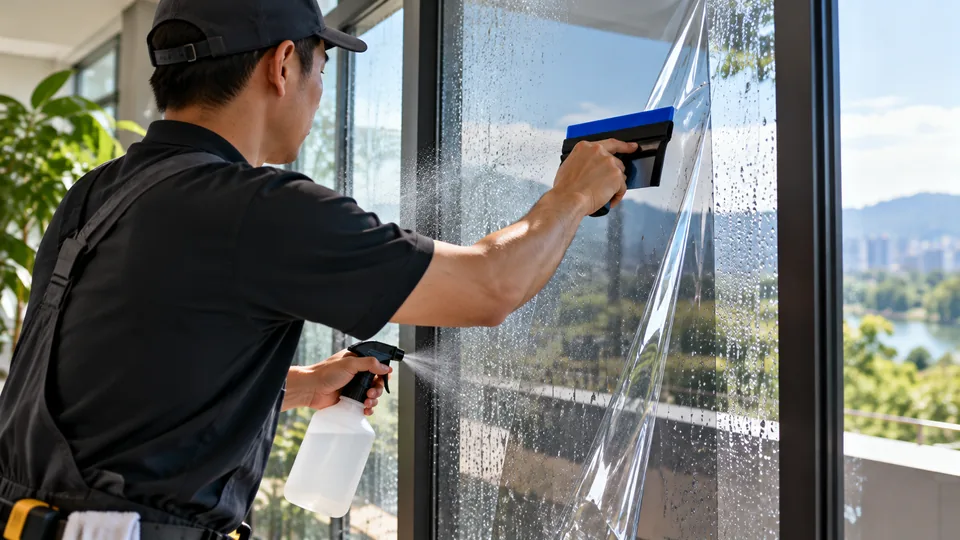
The wet method is how to install window film on house windows with the least risk of bubbles. It works for adhesive privacy, frosted, decorative, solar and heat control films. Work out of direct sunlight at 10–30 °C (50–86 °F), because hot glass dries the solution too quickly.
- Measure and cut the film oversize. Measure the visible glass inside the gasket or bead and cut the film 2–3 cm (about 1 in) larger on every side. Lay it on a clean table, liner side up.
- Clean the glass thoroughly. Spray the glass with application solution and scrape it with a razor blade scraper held flat at about 30 degrees, then squeegee dry and wipe the frame edges with a lint-free cloth. Any speck of dust will show as a bubble.
- Wet the glass generously. Spray the glass again until it is fully wet. The water lets you slide the film into position and pushes out air and dust.
- Peel the liner and wet the adhesive. Peel back the release liner while spraying the exposed adhesive side, so it never touches dry air or your fingers. A piece of tape on each side of a corner helps start the peel.
- Position the film on the glass. Place the wet adhesive side against the wet glass, slide it into position with the top edge slightly overhanging, then spray the outer face of the film so the squeegee glides.
- Squeegee from the center out. Make one vertical stroke down the middle, then work outward in overlapping horizontal strokes with firm, even pressure to push water and air to the edges.
- Trim the edges. Hold a straightedge or hard card against the frame and trim with a sharp snap-off blade, leaving a 1.5–3 mm (1/16–1/8 in) gap at the frame so water can escape and the film does not lift.
- Final squeegee and wick the edges. Re-spray the surface, squeegee again with harder pressure, then wrap a lint-free cloth around a hard card and press along every edge to absorb the last water.
Film often looks slightly hazy or milky for a few days to a few weeks while trapped moisture evaporates through it. Do not clean the film for at least 30 days, and do not try to push out tiny water pockets; they usually disappear on their own as the adhesive cures.
How to install privacy and frosted window film
Frosted, etched-look and patterned privacy film installs exactly as above, with two extra precautions. Align patterned film with a level before squeegeeing, and always finish with a felt-edged squeegee, because a hard squeegee can polish shiny marks into a matte face. Our removable frosted privacy glass film is 120–160 micron PVC, supplied 0.61–1.52 m wide, and is rated for 3–5 years indoors. For style choices, see our privacy window film guide.
Solar, reflective and heat control window film installation
One way privacy window film installation, reflective film and heat control window film go on the same way but need more care. Dark and mirrored films absorb heat, which can cause thermal stress cracks in some double-glazed, laminated or tinted glass. Check the film maker's glass compatibility chart and your window warranty before applying. Exterior window film installation is only suitable for films specifically rated for outdoor exposure.
How to apply static cling window film and window clings
Static cling film is a non adhesive window film: a soft, plasticized PVC that holds to glass by surface tension and static. To install static cling window film, clean the glass, spray it with plain water or a very weak soap solution, lay the film on, and squeegee firmly. It peels off and can be reused, which makes it a good removable window film for home rentals and seasonal window clings.
Static cling holds best on small to medium smooth panes. On large or textured glass, adhesive film is more reliable. Our comparison of static cling vs adhesive window film explains the trade-offs.
How do you fix bubbles, creases and dust spots?
- Water bubbles that remain after a few weeks can be pushed to the nearest edge with a felt squeegee.
- Air bubbles right after installation: lift the nearest edge, re-spray and squeegee again.
- Dust specks: lift the film past the speck while it is still wet, rinse the adhesive and glass, and re-lay.
- Creases cannot be fixed; replace the piece. Creases usually come from handling the film dry or folding it during liner removal.
- Lifting edges: the trim gap is too small or the film is touching the gasket; re-trim and press down.
How to remove window film from house windows
Most window film can be removed in one piece if you soften the adhesive first. The best way to remove window film depends on its age and type:
- Static cling and removable films: lift a corner with a fingernail or blade and peel; wash the glass.
- Newer adhesive films: warm the film with a hair dryer or heat gun on low, held 15–20 cm (6–8 in) away, then peel at a low angle.
- Old solar film or tint: the polyester layer often separates from the adhesive. Use a fabric steamer along the edge while peeling, or the soap-and-sun method: spray soapy water, cover with a black plastic sheet for an hour in the sun, then peel.
After the film is off, spray the leftover adhesive with soapy water or a dedicated window film remover, let it soak a few minutes and scrape with a new razor blade held flat. Finish with glass cleaner. Do not use a razor on low-emissivity or self-cleaning coatings, which are usually on an inner surface of double glazing but sometimes on an exposed face, and test first on tempered glass. Our guide on removing sticker residue and adhesive covers solvents that are safe on glass and window frames.
The same method answers how to remove window tint from house windows: heat or steam, slow peeling, then adhesive removal. It is also how to remove solar film from house windows that were treated years ago. Protect wood frames and sills from solvents and standing water while you work.
Professional vs DIY window film installation cost
DIY window film installation costs only the film and a basic kit. Professional window film installation is usually priced per square foot or square meter of glass, with decorative and privacy films typically at the lower end and high-performance solar or safety films at the higher end. Commercial window film installation in offices adds access equipment and after-hours labor. For a few small windows, DIY is easy; for large panes, high windows or solar film on double glazing, a professional installer is worth the cost.
For installers, glaziers and distributors
If you install or sell glass film, keep a range that covers privacy (frosted, etched, opaque), decoration (patterned, striped), light diffusing film and diffuser film for skylights, and removable grades for rentals. Our office glass partition case study shows frosted and patterned film laid out in full panels and bands. Our decorative film range includes frosted glass films in 0.61, 0.92, 1.22 and 1.52 m widths on 50 m and 100 m rolls, from 1 roll for stock items.
Next step
Send us the glass type, sizes, privacy level and pattern you need, and we will send free A4 samples so you can test application and clarity on your own windows. Contact us for samples and a quotation; we reply within 24 hours.
Frequently Asked Questions
Can you apply window film without water?
Some decorative films are designed for dry application, but most adhesive window films should be applied wet. The slip solution lets you reposition the film, keeps dust from sticking and helps push out air. Applying standard adhesive film dry almost always traps bubbles and makes accurate positioning very difficult.
What is the best solution for applying window film?
The best solution for applying window film is clean water with a very small amount of pure surfactant, such as 2 to 4 drops of baby shampoo per liter. Use distilled water in hard-water areas, and avoid dish soaps with degreasers, lotions or ammonia, which can leave residue or weaken the adhesive.
How long does window film take to cure?
Window film usually cures in a few days to about four weeks, depending on film thickness, temperature and sunlight. During curing the film may look hazy or show small water pockets that disappear on their own. Avoid cleaning or touching the film for at least 30 days after installation.
What is the best way to remove window film from house windows?
The best way is to soften the adhesive first. Warm the film with a hair dryer or steamer, or spray it with soapy water and cover it with black plastic in the sun for an hour, then peel slowly at a low angle. Remove remaining adhesive with soapy water and a flat razor blade.
Can you remove window film and reuse it?
Static cling window film can be removed and reused many times if you store it on its original liner or a smooth plastic sheet. Adhesive window film generally cannot be reused because the adhesive picks up dust and the film stretches or creases during removal. Removable adhesive grades peel cleanly but are still single-use.
How do you apply static cling window film?
Clean the glass thoroughly, spray it with water or a very weak soap solution, peel the cling film from its liner and lay it on the wet glass. Squeegee from the center outward to remove water and air, trim the edges and wipe dry. It holds by static and surface tension, with no adhesive.
Will window film damage double pane windows?
Light decorative and frosted films rarely cause problems, but dark, reflective or high heat-absorbing films can raise glass temperature enough to cause thermal stress cracks or seal failure in some double-pane units. Check the film manufacturer's glass compatibility guidance and your window warranty before applying solar or heat control film.