Key takeaways
- Frosted and etched-look privacy window film diffuses light and gives the same privacy by day and by night.
- One-way mirror window film only works while the outside is brighter than the inside and reverses at night.
- Visible light transmission (VLT) is the percentage of visible light a window film lets through.
- Most privacy films are installed with the wet method using a slip solution of water and a few drops of mild soap.
- Dark or reflective films on large sun-facing double-glazed units can raise glass temperature, so check glazing guidance first.
Privacy window film is a thin adhesive or static-cling film that blocks the view through glass while still letting light in. Frosted and decorative films give privacy day and night; one-way mirror film lets you see out but not in only while it is brighter outside than inside. For full night-time privacy, choose frosted, opaque or add blinds.
This guide explains how each type of privacy film works, which one suits bathrooms, front doors, offices and street-facing windows, how to install it without bubbles, and what trade buyers should specify.
How does privacy window film work?
All privacy films work by changing what happens to light as it passes through glass. There are three basic mechanisms:
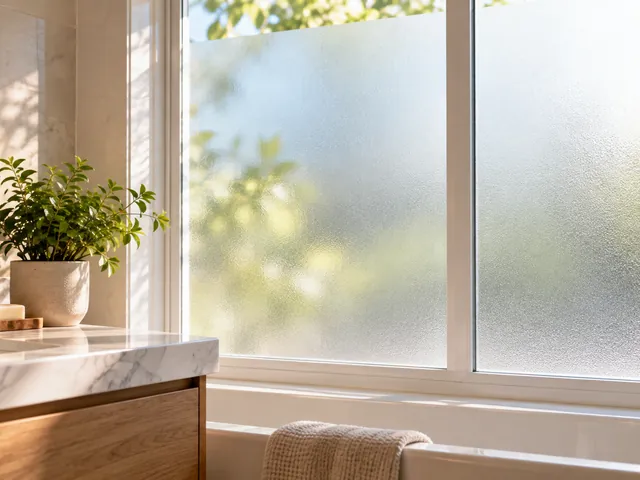
- Diffusion: frosted, etched-look and textured films scatter light, so shapes behind the glass become a soft blur. This works equally in both directions and at any time of day.
- Reflection: mirror window film has a thin metallized layer that reflects a large share of visible light. The brighter side sees a mirror; the darker side sees through.
- Absorption or blocking: tinted, black and blackout films absorb or block light. Dark tints reduce visibility, and opaque films stop it completely.
Two numbers matter when comparing films. Visible light transmission (VLT) is the percentage of visible light that passes through; a clear film may be 85–90% VLT, a mirror film 5–20%. Visible light reflectance tells you how mirror-like the outside looks.
Types of privacy window film compared
| Film type | Daytime privacy | Night-time privacy | Light let in | View out | Typical uses |
|---|---|---|---|---|---|
| Frosted / etched glass film | High | High | High (diffused) | No | Bathrooms, front doors, office partitions |
| Decorative patterned film | Medium to high | Medium to high | High | Partial | Sidelights, kitchens, glass doors |
| Stained glass film | Medium | Medium | Medium, colored | Partial | Transoms, stair windows, feature glass |
| One way mirror window film | High (from outside) | Low, reverses | Low to medium | Yes, by day | Street-facing living rooms, offices |
| Gradient film | High at the frosted band | High at the band | High | Above the band | Ground-floor windows, conference rooms |
| Black, blackout or light blocking film | Total | Total | None to low | No | Bedrooms, basements, storage, shift workers |
| Smart (switchable) electronic window film | On demand | On demand | High when clear | When clear | Meeting rooms, hospital rooms, high-end homes |
One way window film: can you see out but not in?
Privacy window film see out not in is the most searched feature, and the most misunderstood. One way window film is a reflective mirror film. During the day, the outside is far brighter than the room, so the outside face acts like a mirror and passers-by see their reflection while you still see out. This is why it is also sold as one way mirror window film, 1 way mirror film or two way mirror film, although the effect depends on light, not on the film being directional.
At night the situation reverses. With lights on inside and darkness outside, people outside can see in, and you see your own reflection. No film provides one way window film day and night privacy on its own. For night time privacy window film performance, combine mirror film with blinds or curtains, or choose a frosted or gradient film in the lower part of the window.
1 way glass film, 2 way mirror film: what the names mean
One way privacy window film, one way glass film for windows, one way mirror glass film, one sided mirror window film, 2 way mirror film and two way window film are all marketing names for the same reflective, metallized film. Chrome window film and silver mirror film are the most reflective; bronze and smoke versions are less mirror-like and slightly darker. None of them turns glass into a true one way glass window in all lighting.
What is the best window film for day and night privacy?
For genuine day and night privacy window film, choose a diffusing film: frosted, etched, textured, opaque white or a dense decorative pattern. These look the same from both sides and do not depend on light levels. A practical compromise is a mirror film on the upper glass for daytime views and a frosted band across the lower 1–1.2 m (40–48 in), the height of a seated or standing person.
Mirror film and double glazing: a caution
Reflective and dark films absorb and reflect solar energy, which can raise the temperature of the inner pane. On large, sun-facing double-glazed or laminated units this can, in rare cases, cause thermal-stress cracking. Check the glazing manufacturer's guidance before applying dark or mirror film to sealed units; frosted films carry much lower risk.
Bathroom window privacy film
Bathroom window privacy needs to work at night with lights on, so mirror film is the wrong choice. Window film for bathroom window glass should be frosted, etched-look or a dense pattern. Frosted film lets in most of the daylight while blurring shapes completely, which is why it is the standard answer to bathroom window privacy ideas and shower window privacy film.
- Apply on the dry, inside face of the glass; do not apply film to textured or obscure glass, which already scatters light and prevents adhesion.
- For a shower window film, choose a waterproof PVC film and trim the edges 1–2 mm from the frame so condensation drains.
- Our white frosted etched privacy glass film is a 0.14–0.16 mm PVC film in 0.61 m and 1.22 m widths by 50 m, rated for 3–5 years indoors.
Our frosted window film guide covers frosted grades, patterns and how much light each lets through.
Decorative privacy window film, stained glass and gradient designs
Decorative privacy window film adds pattern while controlling sightlines. Popular styles include reeded and fluted glass looks, geometric frosted stripes, floral window film, mosaic window film, and holographic or chameleon window film that throws rainbow light in sunlight. Stain glass privacy film imitates leaded colored glass and suits front door transoms and stair windows.
Window graphics are a related category: a sticker on the window, cut-vinyl window signs and decals rear window lettering on vehicles are made from cutting vinyl rather than privacy film, and are covered in our sign-vinyl guides.
Gradient window film fades from frosted to clear, keeping a view above eye level. Striped and banded designs are common on office glass, where safety regulations in many countries also require visibility markings on full-height glazing. See our guide to office glass film and window graphics for commercial layouts.
Smart, electronic and intelligent glass film
Electronic window film, also called intelligent glass film or switchable PDLC film, contains liquid crystals that scatter light when the power is off and align to turn clear when a low voltage is applied. It is a privacy glass switch for meeting rooms and hospital rooms, but it needs wiring, a power supply and professional installation, and it costs far more than passive films. It is not the same as polarized windows, which use polarizing filters and are mostly a feature of specialty glazing.
Static cling vs adhesive privacy film
Peel and stick window film, including peel and stick window privacy film sold for DIY use, comes in two attachment styles. Static cling film holds by surface tension and static, contains no adhesive, and can be removed and repositioned, which suits renters. Adhesive window film uses a pressure-sensitive adhesive that bonds more permanently and handles temperature changes, humidity and larger panes better. For bathrooms, doors and commercial glass, adhesive privacy window film is usually the longer-lasting choice. Our static cling vs adhesive window film comparison explains when each wins.
How to install privacy window film
Most privacy films install with the wet method: a slip solution lets you slide the film into position, then you squeegee the water out. Work at 10–30 °C (50–86 °F) and avoid direct sun on the glass while installing.
- Measure the glass. Measure the visible pane and cut the film about 2–3 cm (1 in) larger in both directions.
- Clean thoroughly. Scrape the glass with a razor blade scraper, wash it, and clean the edges and corners; a single speck of dust makes a bubble.
- Mix a slip solution. Add a few drops of baby shampoo or mild dish soap to a spray bottle of water.
- Wet the glass and the film. Spray the glass generously, peel the liner from the film, and spray the adhesive or cling side as you peel.
- Position the film. Lay the wet side on the glass and slide it into position, leaving the excess over the frame.
- Squeegee from the center. Spray the outer face, then squeegee from the center outward to push out water and air.
- Trim the edges. Trim with a sharp blade against a straightedge, leaving a 1–2 mm gap from the frame, and squeegee the edges again.
- Let it dry. Leave the film to cure for several days; a slight haze or tiny water pockets normally disappear as moisture evaporates.
To remove adhesive film later, peel a corner, spray soapy water behind it as you pull at a low angle, and scrape off any residue with a razor blade on glass. Our full guide to installing and removing window film covers large panes and seaming.
Privacy film vs other window treatments and window coverings
Window film is one of many window treatments. Compared with blinds, shutters and curtains, privacy window film keeps daylight, has no cords or moving parts, suits awkward shapes such as door sidelights and transoms, and costs relatively little. Its limit is that most films cannot be opened: frosted film blocks the view permanently. Many homeowners combine privacy film on the lower glass with conventional window coverings for darkness and insulation.
Specialty films serve other jobs. Safety and security films (often marketed as hurricane window film, anti smash window film or even bullet proof film for windows) are thicker polyester films that hold broken glass together; they slow intrusion and reduce flying glass, but they do not make ordinary glass bulletproof or hurricane-proof. Heat control and UV films reduce glare and fading, and clear window film or protective film for glass guards against scratches during building work.
Cost of window film for home: DIY vs professional
The cost of window film for home projects depends mostly on film type and who installs it. DIY window film is the cheapest route: frosted and decorative PVC films are inexpensive per square meter, and precut window film panels sized for standard doors and sidelights save cutting. Professional installation adds labor but is worth it for large panes, high windows and mirror or security films that are harder to handle. Custom window film, printed or cut to your design, costs more than stock patterns but suits shop fronts and offices.
Exterior and outdoor window film
Most privacy films are made for the inside face of the glass. Exterior window film and outdoor window film are built with UV-stable adhesives and harder top coats for rain and sun, and are used where the inside face is inaccessible or on single glazing in conservatories. Interior-grade film applied outside typically fails within months. Window protection film for construction sites is a different, temporary product designed to peel off cleanly.
For installers, retailers and office fit-out contractors
For trade buyers, specify film type and finish, thickness (frosted PVC films commonly run 0.10–0.16 mm), width to suit the glazing (0.61, 0.92, 1.22 and 1.52 m are standard), roll length, adhesive or cling, and liner. Approve a sample under the actual lighting conditions, because frosted density looks different in daylight and at night. Our office glass partition privacy project shows how full-panel and band layouts are planned.
Next step
Send us the film type, pattern, thickness, roll width and length, and quantity, plus where the film will be used. We supply free A4 samples and quote within 24 hours through our contact page.
Frequently Asked Questions
Does one way window film work at night?
No. One-way mirror film relies on the outside being brighter than the inside. At night, with lights on indoors, the effect reverses and people outside can see in while you see a reflection. For night-time privacy, pair mirror film with blinds or curtains, or use frosted, opaque or gradient privacy film instead.
What is the best window film for privacy day and night?
Frosted, etched-look, textured and opaque films give the most reliable day and night privacy because they diffuse or block light equally in both directions, regardless of which side is brighter. Dense decorative patterns also work. A frosted band across the lower part of the window keeps privacy while preserving the view above.
Can you see out of frosted privacy window film?
Not clearly. Frosted privacy window film scatters light, so from either side you see only soft shapes and light, not detail. That is what makes it suitable for bathrooms and front doors. If you need a view out, choose a gradient or banded frosted film that leaves the upper glass clear, or a mirror film for daytime use.
What privacy film is best for a bathroom window?
Use a frosted, etched-look or densely patterned film, because bathroom privacy is needed at night when one-way mirror film stops working. Apply it to the smooth inside face of the glass, choose a waterproof PVC adhesive grade for steamy rooms, and leave a 1 to 2 mm gap at the frame so condensation can drain.
Is privacy window film easy to remove?
Static cling film peels off by hand and can be reused. Adhesive film is also removable: lift a corner, spray soapy water behind it as you peel slowly at a low angle, then scrape any remaining adhesive from the glass with a razor blade scraper and clean with glass cleaner. Older film in strong sun may take longer.
How long does privacy window film last?
Indoor privacy window film typically lasts several years; frosted PVC films are commonly rated for around 3 to 5 years indoors, and polyester films often longer. Lifespan depends on sun exposure, cleaning methods and humidity. Clean with a soft cloth and mild soapy water, and avoid abrasive pads or ammonia cleaners on the film.
Can you put privacy film on double pane windows?
Usually yes, especially light-colored frosted films. Dark or mirror films absorb more solar energy, which can heat the inner pane of a sealed double-glazed unit and, in rare cases, cause thermal-stress cracking on large sun-facing windows. Check the window manufacturer's guidance before using dark or reflective film on insulated glass.
Does privacy window film let light in?
Yes, most privacy films let in plenty of light. Frosted film typically transmits a high share of daylight while blurring the view, and decorative patterns let in even more through their clear areas. Mirror films let in less light, and blackout or light blocking film for windows is designed to stop light almost completely.