Key takeaways
- Vinyl refrigerator wraps are typically 100 to 200 micron PVC film, thicker than basic contact paper so they hide dents and wrap door edges.
- A French-door refrigerator usually needs about 2.5 to 3 meters of 1.22 meter wide film for the fronts, plus 15 to 20 percent extra.
- Degreasing with isopropyl alcohol and wrapping the film at least 1 to 2 cm around each door edge are the keys to preventing lifting.
- PVC film softens at around 60 to 80 degrees C, so it should not be used on oven doors, cooktops or near appliance vents.
- Adhesive contact paper should not be used inside a refrigerator, because condensation lifts it; washable non-adhesive shelf liners work better.
Vinyl refrigerator wraps are sheets of self-adhesive PVC film, typically 100–200 micron thick, applied to the doors and sides of a fridge, dishwasher or other appliance to change its color or finish. With a clean surface, a heat gun for edges and careful trimming, one person can wrap a standard refrigerator in three to five hours.
An appliance wrap is the cheapest way to fix a mismatched or scratched appliance, turn white into black or stainless, or add a custom design. This guide covers which film to buy, how much you need, how to wrap a refrigerator step by step, and what to expect on dishwashers, ovens and backsplashes.
What are vinyl refrigerator wraps and appliance wraps?
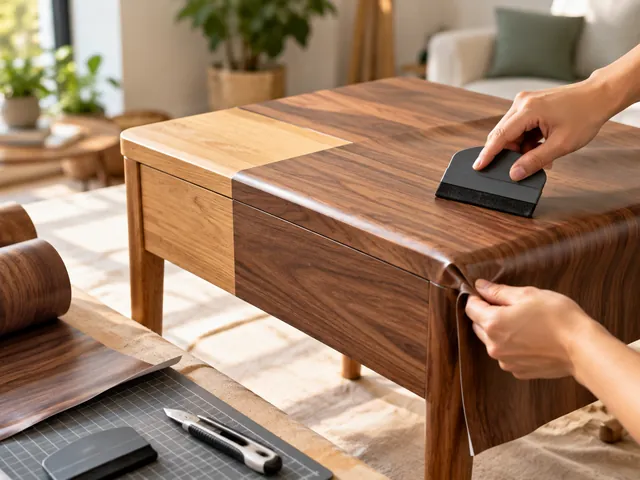
An appliance vinyl wrap is the same kind of film used for furniture and signage: a PVC face film, a pressure-sensitive adhesive (PSA) and a release liner. Kitchen appliance wraps differ from basic contact paper in three ways:
- Thicker film. Appliance wraps are usually 100–200 micron (about 4–8 mil). Thin 60–80 micron contact paper wrinkles around handles and shows dents.
- Conformability. Good wraps soften with gentle heat so they stretch around rounded door edges, then hold their shape when cool.
- Adhesive. Refrigerator door wraps flex every time the door opens, so adhesive matters. A permanent or high-tack adhesive holds on painted steel through temperature changes; a removable grade suits rentals but needs careful edge sealing.
Common finishes are gloss and matte solid colors, brushed stainless steel, black, wood grain, marble and fully custom printed designs. Our article on matte, gloss and metallic vinyl film finishes explains how each one looks and wears.
Which vinyl is best for a fridge wrap?
| Film type | Typical thickness | Best for | Limitations |
|---|---|---|---|
| Stainless steel contact paper (printed or brushed metallic PVC) | 80–150 micron | Making white or almond appliances match stainless | Brushed grain must run in one direction; seams show |
| Solid-color furniture film (gloss or matte) | 120–200 micron | Black vinyl wrap for appliances, retro colors, white refresh | Gloss shows dents and dust under the film |
| Calendered cutting vinyl (permanent) | 80–100 micron | Accents, stripes, lettering, small appliances | Less stretch on deep curves |
| Printed vinyl with laminate | About 150–200 micron combined | Custom refrigerator wraps with photos or artwork | Needs a print shop and lamination |
| Aluminum foil backsplash film | Foil and PVC laminate | Walls behind ranges, stainless backsplash look | For flat surfaces, not appliance doors |
For most refrigerator wrapping projects, a 120–200 micron solid-color or metallic decorative film is the practical choice. Our furniture and decorative films come in gloss, matte and pearlescent solid colors on 1.22 m (48 in) wide rolls, wide enough to cover most fridge doors in a single piece. For lettering and accents, our cutting vinyl is 80–200 micron in permanent and removable grades.
How much vinyl do you need to wrap a refrigerator?
Measure each door and visible side panel, then add 5 cm (2 in) on every edge for wrapping and trimming. A typical guide for film 1.22 m (48 in) wide:
- Top-freezer or bottom-freezer fridge, fronts only: about 2–2.5 m (7–8 ft).
- French-door fridge, fronts only: about 2.5–3 m (8–10 ft).
- Side panels: add about 1.8 m (6 ft) per exposed side.
- Dishwasher front: about 0.8–1 m (2.5–3.5 ft).
Order 15–20% extra. Most people ruin at least one piece on their first wrap, and a pre-cut fridge wrap kit rarely fits every model exactly. Narrow 0.61 m (24 in) film works but forces a seam on wide doors.
How to wrap a refrigerator with vinyl
- Remove handles and trim. Unscrew door handles, badges and removable trim strips so the film can run underneath. Keep screws in labeled bags.
- Clean and degrease. Wash the doors with warm water and dish soap, then wipe with isopropyl alcohol. Kitchen grease is the main reason wraps lift at the edges.
- Bring everything to room temperature. Work at about 18–25 °C (65–77 °F). Let the film sit in the kitchen for a few hours first.
- Cut oversized panels. Cut each piece 5 cm (2 in) larger than the door on every side. On brushed metallic film, mark the grain direction on the liner.
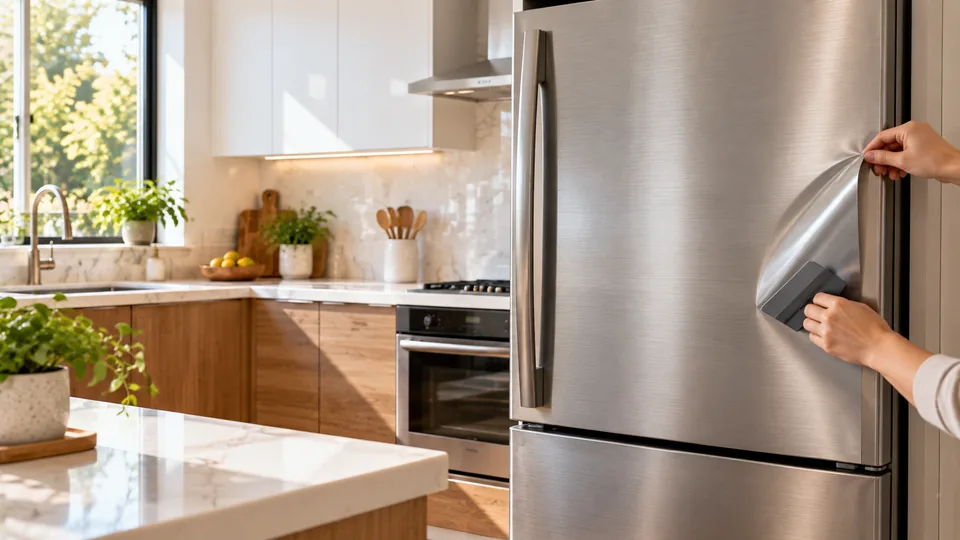
- Apply from the top down. Peel 15–20 cm (6–8 in) of liner, align the top edge, and smooth with a felt squeegee in overlapping strokes from the center outward, pulling the liner away as you go.
- Heat and wrap the edges. Warm the edge with a heat gun on low or a hairdryer, stretch the film around the door edge and press it onto the inside face by at least 1–2 cm.
- Trim and cut openings. Trim with a fresh snap-off blade. Locate handle holes by feel, pierce with the knife tip and cut a small cross.
- Post-heat and reassemble. Go over all stretched edges with gentle heat to relax the film, then reinstall handles. Avoid cleaning the surface for 48 hours.
Do not cover door gaskets, vents or the rear condenser area. Gaskets must seal against the cabinet, and vents need airflow. Our guide on installing self-adhesive film without bubbles has more squeegee technique.
Stainless steel wrap for appliances: getting the brushed look right
A stainless steel wrap for appliances is the most requested finish, because it lets an older white fridge match a new stainless range. Stainless contact paper is either printed with a brushed pattern or made with a metallic layer under an embossed brushed texture; the second looks more convincing in raking light. For a stainless steel vinyl wrap for appliances that looks real:
- Run the brushed grain vertically on fridge doors and horizontally on dishwashers and drawers, matching how factory stainless is finished.
- Cut every panel from the same roll so the tone matches; batches can differ slightly.
- Avoid seams on visible door faces. A stainless steel wrap for a fridge should be one piece per door, which is why 1.22 m (48 in) film is preferred.
- Use a matte or satin stainless appliance wrap rather than mirror chrome; mirror films show every ripple.
Some sellers call cheaper thin films contact paper for appliances or appliance wrapping paper. These work on flat, cool panels for a short-term look, but for fridge coverings that last, choose a film of at least 100 micron.
Wrapping dishwashers, ovens and other appliances
The same method applies to most kitchen appliances, with a few limits:
- Dishwashers: wrap the front panel only, keeping film away from the door seal and control panel buttons unless they are flat touch controls.
- Ovens and ranges: using stainless steel contact paper on an oven is suitable only for side panels and lower drawer fronts. Oven doors, cooktops and areas near vents get too hot for PVC film, which softens at around 60–80 °C (140–175 °F).
- Microwaves and small appliances: fine on the outer casing, never over vents.
- Washing machines and dryers: good candidates, as their panels are flat and stay cool.
Stainless steel backsplash tiles and stainless peel-and-stick backsplash
If your appliances are stainless, a matching wall behind them ties the kitchen together. Stainless backsplash tiles come in two forms: real thin stainless steel tiles with an adhesive back, and printed or foil-laminated vinyl that imitates stainless. A stainless peel and stick backsplash in film form is much lighter and easier to cut.
Behind a range, choose a heat-resistant film. Our thickened aluminum foil kitchen sticker is an aluminum foil and PVC laminate that is oil-proof and heat-resistant, supplied in 0.61 m × 3 m rolls. It suits peel and stick backsplash stainless steel looks as well as plain protection behind a stove.
Refrigerator lining and shelf liner for the fridge
Refrigerator lining usually means a liner for the refrigerator shelves and drawers, not the exterior. A shelf liner (fridge shelves and crisper drawers) should be food-safe, washable and non-adhesive or lightly adhesive so you can remove it for cleaning. EVA foam or textured PVC mats are common; avoid adhesive contact paper inside the fridge, because condensation lifts it and moisture can collect underneath. See our shelf liner and drawer liner guide for options.
How long does a vinyl wrap on a fridge last?
A well-applied refrigerator skin wrap or vinyl wrap for a fridge typically lasts several years indoors. Failures almost always start at edges near handles, where hands pull at the film, and at the bottom of the doors, where feet and mops hit it. To extend its life:
- Clean with mild soap and a soft cloth; avoid solvents and abrasive pads.
- Re-press any lifting corner immediately with gentle heat.
- Keep the wrap away from oven doors and toaster vents.
- Choose a removable adhesive if you rent, and test a small hidden area first, as some factory paints are softer than others.
If you are planning a wider update, wrapping is also a large saving within a small kitchen remodel; the cost of a small kitchen remodel without appliances is usually dominated by cabinets and counters, which can be wrapped too, so small kitchen remodel cost without appliances replaced can fall sharply.
For wrap installers and retailers
Installers and retailers selling refrigerator wrap kits or appliance wrap kits need consistent color between batches and a film that heats and stretches predictably. We supply decorative PVC film on 1.22 m × 50 m rolls and cutting vinyl in 0.61 m and 1.22 m widths, with custom colors from 100 rolls and private-label packaging.
Next step
Send us the finishes and colors you need, the roll width and quantity, and whether you want permanent or removable adhesive. Contact us for free A4 samples to test on your appliances and a quotation within 24 hours.
Frequently Asked Questions
Can you wrap a refrigerator in vinyl?
Yes, you can wrap a refrigerator in vinyl using self-adhesive PVC film of about 100 to 200 micron. Remove the handles, degrease the doors with isopropyl alcohol, apply the film from the top down with a felt squeegee, and heat it around the door edges. Keep film off the door gaskets, vents and rear condenser.
How long does a vinyl wrap on a fridge last?
A properly applied vinyl wrap on a fridge typically lasts several years indoors. Wear usually starts at edges near the handles and at the bottom of the doors. Cleaning with mild soap, avoiding solvents, re-pressing lifting corners with gentle heat and wrapping the film around door edges all help it last longer.
Is stainless steel contact paper good for appliances?
Stainless steel contact paper is a good way to make white or almond appliances match stainless ones, as long as you choose a thicker film of around 100 to 150 micron. Run the brushed grain in one direction on every panel, avoid seams on doors, and keep it away from oven doors and other hot areas.
Can you put contact paper on an oven?
Contact paper can go on oven side panels and lower drawer fronts that stay cool, but not on the oven door, cooktop or near vents. PVC film typically softens at around 60 to 80 degrees C (140 to 175 degrees F), so it can bubble, shrink or discolor on surfaces that get hot during cooking.
How much vinyl do I need to wrap a fridge?
For the fronts of a typical top-freezer or bottom-freezer fridge you need about 2 to 2.5 meters of 1.22 meter wide vinyl, and for a French-door fridge about 2.5 to 3 meters. Add around 1.8 meters per exposed side panel, then order 15 to 20 percent extra for mistakes and trimming.
Does an appliance wrap damage the finish?
An appliance wrap with a removable adhesive usually comes off factory-painted steel cleanly, especially within the first few years. Permanent adhesives bond harder and may leave residue that needs an adhesive remover. Test a small hidden area first, peel slowly at a low angle, and warm the film with a hairdryer during removal.
What is the best liner for refrigerator shelves?
The best liner for refrigerator shelves is a washable, food-safe mat such as EVA foam or textured PVC that is non-adhesive or only lightly adhesive. It cushions glass shelves and catches spills, and you can lift it out to clean. Adhesive contact paper is a poor choice inside a fridge because condensation lifts it.