Key takeaways
- Iron on letters are most often cut heat transfer vinyl, which bonds to fabric with heat and pressure.
- Typical HTV press settings are 150–180 °C for 10–15 seconds at medium to firm pressure.
- DTF and sublimation transfers reproduce full-color logos, but sublimation works only on light-colored polyester.
- Back numbers on sports jerseys are commonly 20–25 cm (8–10 in) tall, though leagues may set their own rules.
- Waiting 24 hours before the first wash and washing inside out helps iron-on transfers last longer.
Iron on letters are pre-cut heat transfer letters, numbers or patches that bond to fabric with heat and pressure from a household iron or heat press. The most durable for shirts and jerseys are cut heat transfer vinyl (HTV); custom heat transfers printed by DTF, sublimation or screen printing suit full-color logos, and embroidered patches suit a textured, premium look.
This guide compares the main types of custom iron on transfers, explains how to size and apply letters and numbers, covers heat transfer labels for garments, and lists what to specify when ordering in volume.
What types of iron on letters and custom heat transfers are there?
"Iron on" covers several quite different products. They all use a heat-activated adhesive, but the decoration layer differs:
- Heat transfer vinyl (HTV) letters: letters and numbers cut from a solid-color PU or PVC film on a clear carrier, then weeded. Iron on vinyl letters are the standard for team names and numbers.
- DTF (direct-to-film) transfers: full-color designs printed onto a PET film, coated with adhesive powder and cured. A DTF transfer custom order can reproduce photos and gradients.
- Sublimation transfers: dye-based prints that turn to gas and dye polyester fibers directly. Custom sublimation transfers have no feel at all but work only on light-colored, high-polyester fabric.
- Screen-printed (plastisol) transfers: ink screen-printed onto release paper, then heat-pressed. Economical for large runs of one design.
- Embroidered and chenille patches: letter embroidered patches, clothing patches letters and chenille letters with a heat-seal backing, used on jackets, hats and varsity wear.
| Method | Best for | Colors | Fabrics | Hand feel | Economical run size |
|---|---|---|---|---|---|
| HTV (cut vinyl) | Names, numbers, simple logos | 1–3 solid colors | Cotton, polyester, blends | Thin, smooth | 1 to hundreds |
| DTF transfers | Full-color logos, artwork | Unlimited | Almost all fabrics | Thin, slightly rubbery | 1 to thousands |
| Sublimation | All-over prints, sportswear | Unlimited | White or light polyester only | None (dyed in) | 1 to thousands |
| Screen-printed transfers | One design in volume | Spot colors | Cotton, blends | Medium | Hundreds and up |
| Embroidered patches | Premium logos, letterman jackets | Thread colors | Heavier fabrics, denim, caps | Raised, textured | Dozens and up |
For a deeper side-by-side, see our comparison of HTV vs DTF vs sublimation vs screen printing.
Iron on letters for shirts, jerseys and clothing
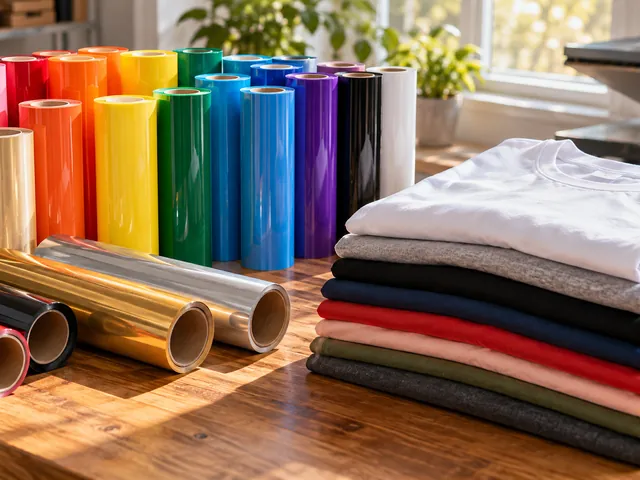
Iron on letters for shirts and iron on tee shirt letters are most often HTV, because a single color of film can be cut into any font and size in minutes. HTV letters sit on the surface as a thin, flexible layer, and PU-based HTV stretches with knit fabric without cracking. Our heat transfer vinyl range includes PU and PVC films in 0.5 m and 0.61 m widths with matte, glossy and shimmer finishes.
Iron on letters and numbers for team jerseys
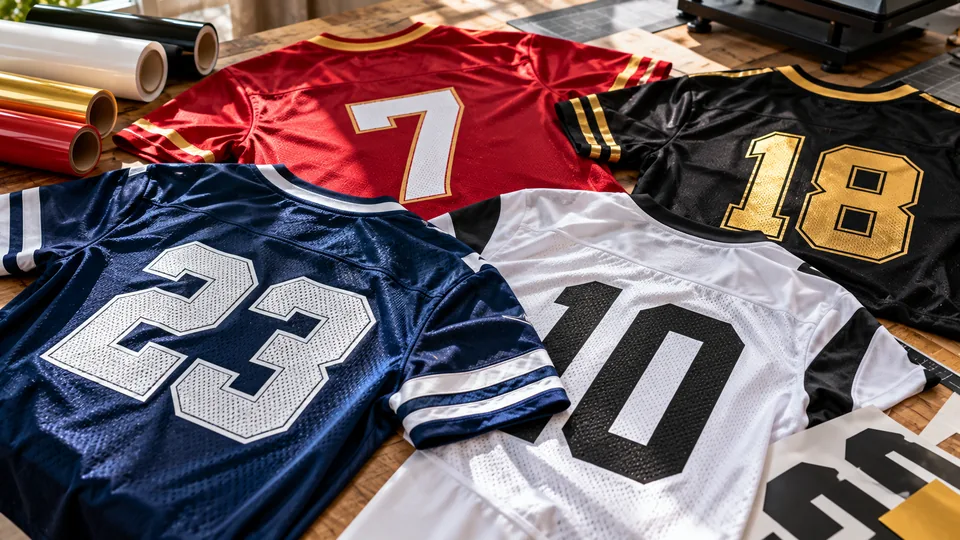
Sports jerseys are polyester knits that stretch and are washed constantly, so letters and numbers need a high-elastic, high wash-fastness film. Our high-washable PU heat transfer vinyl is an ultra-thin 75 micron film made for football jersey names and numbers. Common size conventions, which leagues may set differently, are:
- Back numbers: often 20–25 cm (8–10 in) tall.
- Front or chest numbers: often 10 cm (4 in).
- Player names: often 5–7.5 cm (2–3 in) tall, arched or straight.
- Sleeve or shorts numbers: often 7.5–10 cm (3–4 in).
Our guide to PU vs PVC HTV for team jerseys explains how stretch, thickness and wash-fastness differ.
Small iron on letters, fonts and fabric letters
Small iron on letters, such as 1/2 inch (13 mm) iron on letters for names on uniforms, school bags or labels, need a thin film and a clean cut. As a guide, keep strokes no thinner than about 1 mm (0.04 in) so they weed and survive washing. Iron on alphabet letters and iron on fabric alphabet letters sold in sets are usually pre-cut HTV, felt or twill. Iron on fabric letters in felt or twill (often called iron on applique letters) give a classic collegiate look but need stitching around the edge for long-term durability. Iron on letters white and black are the most-used colors; metallic gold and silver are popular for numbers.
Custom iron on transfers and logos
Custom iron on logos, custom made iron on logos and iron on logos for shirts for businesses, clubs and events can be produced in three ways depending on the artwork:
- Simple one- or two-color logos: cut HTV, layered if needed. Custom heat transfer vinyl gives crisp edges and a durable finish.
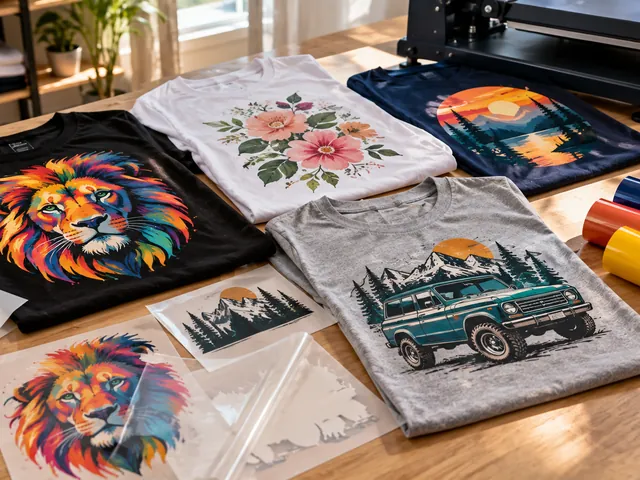
- Full-color logos and gradients: custom DTF transfers for t shirts (custom direct to film transfers), or custom dye sublimation transfers for light polyester.
- Repeat orders of one logo: screen-printed custom heat press transfers lower the per-piece cost at higher quantities.
To order custom heat transfers for shirts or custom heat transfers for clothing, send vector artwork (AI, EPS, SVG or PDF with outlined fonts) for cut vinyl, or a 300 dpi PNG with a transparent background at final size for printed transfers. Specify the finished size, the garment color and fabric, and the quantity of each size. The same applies to custom iron on transfers for shirts, custom iron on vinyl transfers, iron on decals custom-made for events, iron on stickers for clothes custom-printed for children, and custom decals for shirts sold by print-on-demand stores. A heat transfer logo should be checked at actual size on a sample garment before a full run.
Custom transfer stickers for glass and hard surfaces
Custom transfer stickers, custom transfer decals and logo transfer stickers for glass, laptops, cups and vehicles are a different product: they use adhesive cutting vinyl and transfer tape, not heat. Personal logo stickers, custom logo design stickers and a custom business sticker for packaging are made the same way, from printed or cut adhesive vinyl, and the cheapest custom stickers online are usually printed in large sheets and kiss-cut.
How to use iron on letters: step by step
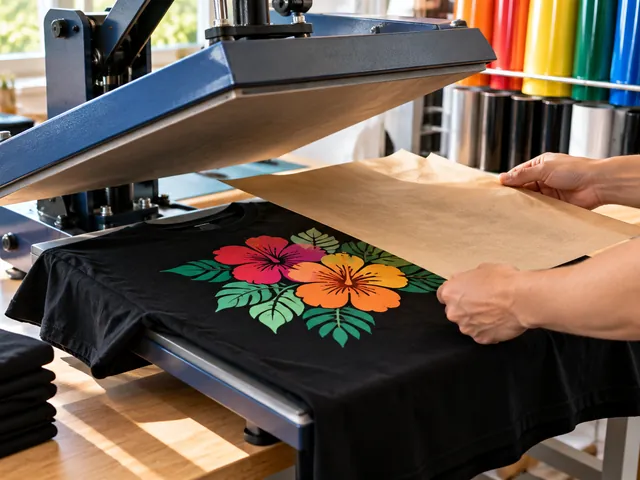
This method works for HTV letters and most custom heat transfers. Always follow the specific film's settings; typical HTV values are 150–180 °C (300–355 °F) for 10–15 seconds at medium to firm pressure on a heat press.
- Prewash the garment without fabric softener, which leaves a coating that blocks adhesion.
- Plan placement. For an adult shirt, the top of a chest design is usually 7.5–10 cm (3–4 in) below the collar. Fold the shirt in half to crease a center line.
- Pre-press the fabric for 3–5 seconds to remove moisture and wrinkles.
- Position the letters with the carrier sheet shiny side up, using a ruler or heat-resistant tape to keep lines straight.
- Cover and press. Place a cover sheet or parchment over the design. With a heat press, press at the recommended temperature and time. With a household iron, use the cotton setting with no steam and press firmly, without sliding, for about 20–30 seconds per area on a hard surface.
- Peel the carrier hot or cold, as specified. If letters lift, lay the carrier back down and press again for a few seconds.
- Finish and cure. Press the design again for 2–3 seconds through a cover sheet, and wait 24 hours before the first wash.
For iron versus heat press details, see how to apply heat transfer vinyl.
How to iron on embroidered letters and patches
If you are wondering how to iron on transfer letters that are embroidered rather than vinyl, the process is similar but slower. Iron on embroidered letters, iron on letter patches and iron on patches letters need longer, hotter contact because the thick embroidery insulates the adhesive. Press from the back of the fabric as well as the front, typically for 30–45 seconds with an iron, then let it cool. For jackets and bags that see heavy use, a few hand stitches at the corners make embroidery iron on letters permanent.
Heat transfer labels for apparel and garments
Heat transfer labels are printed tagless labels applied inside garments, typically at the back neck, in place of sewn woven tags. Heat transfer labels for apparel carry the brand logo, size, fiber content and care symbols, and are applied with a small label press in a few seconds. Heat transfer neck labels and heat press labels for clothing feel softer than woven labels and cannot be cut out, which helps keep care and origin information on the garment. Woven heat transfer label options with a heat-seal backing are a middle ground. Heat transfer clothing labels, heat transfer tags and heat press garment labels all describe the same idea, and DTF labels are increasingly used for full-color brand marks inside the neck.
When ordering custom heat transfer labels or custom shirt tags heat transfer runs, confirm the fabric types, wash temperature, size breakdown and whether reflective heat transfer labels are needed for safety garments. How much does it cost to print a label? It depends mainly on quantity, colors and size, with per-piece cost falling steeply as volume rises.
How to make iron on letters last
- Wait 24 hours before the first wash.
- Turn garments inside out and wash cold or warm, below the temperature the film is rated for.
- Avoid bleach and fabric softener; tumble dry low or hang dry.
- Never iron directly on the transfer; iron inside out or through a cloth.
When a supplier quotes a wash rating, ask at what temperature it was tested and on which fabric, because a film rated for many washes at 40 °C may perform differently at 60 °C.
Where to buy iron on letters and custom heat transfers
Where to buy iron on letters depends on how many you need. For a single shirt, craft and fabric stores sell pre-cut iron on letters for clothing in standard fonts, felt and HTV, and they are where to get iron on letters the same day. For custom iron on letters in your own font, color and size, a local print shop or online transfer service can cut them from custom HTV, or you can cut your own with a desktop cutting machine and a roll of custom shirt vinyl.
For businesses, the economics change with volume:
- Print-on-demand and small runs: buy HTV by the roll and cut in-house; per-letter cost is very low and colors stay consistent.
- Full-color logos: order custom heat transfer printing as gang sheets of DTF transfers; cheap custom heat transfers are usually gang sheets that pack many designs onto one film.
- Large repeat orders: screen-printed transfers or heat transfer sheets custom-printed in bulk lower the cost per piece.
Whichever route you take, ask for a sample of the film or transfer on your own fabric before committing to a squad, a uniform program or a retail range of custom t shirt vinyl designs.
For print shops, teamwear decorators and brands
If you produce custom heat transfers for clients, buying HTV by the roll keeps cost per letter low and color consistent across reorders. Standardize a core palette, trial each film on your typical fabrics with your press, and keep a retained sample of approved batches. Our amateur league kit customization project shows how a sample garment is used to approve stretch, adhesion and lay-flat before a squad order.
Next step
Tell us the film type (PU or PVC), finish, colors, roll width and quantity, plus the fabrics you decorate. We send free A4 samples and quote within 24 hours via our contact page.
Frequently Asked Questions
How do you use iron on letters?
Prewash the garment, pre-press it to remove moisture, and position the letters with the clear carrier facing up. Cover with parchment or a cover sheet and press firmly with a heat press or a dry iron on the cotton setting, without sliding. Peel the carrier hot or cold as directed and wait 24 hours before washing.
Can you use a regular iron for iron on letters?
Yes. Use the cotton setting with steam turned off, work on a hard, heat-safe surface rather than an ironing board, and press firmly for about 20 to 30 seconds per area without sliding the iron. A heat press gives more even temperature and pressure, so it is preferred for team jerseys and larger runs.
What is the best material for iron on letters for shirts?
For most shirts, PU heat transfer vinyl is the best material for iron on letters because it is thin, soft, stretches with knit fabric and withstands repeated washing. PVC vinyl is thicker and more economical for structured items such as bags. Embroidered or felt letters suit a textured collegiate look but benefit from stitching.
What size should iron on numbers be for jerseys?
Common conventions are 20 to 25 cm (8 to 10 in) for back numbers, about 10 cm (4 in) for front numbers, and 7.5 to 10 cm (3 to 4 in) for sleeves or shorts. Player names are often 5 to 7.5 cm (2 to 3 in) tall. Always check your league rules, which may set exact sizes.
What is the difference between custom heat transfers and HTV?
HTV is a solid-color film cut into letters or shapes and weeded, best for names, numbers and simple logos. Custom heat transfers usually means printed designs, such as DTF, sublimation or screen-printed transfers, that reproduce full-color artwork and arrive ready to press. Both use heat-activated adhesive and similar press steps.
Do iron on letters come off in the wash?
Properly applied iron on letters should survive many washes. Most failures come from too little heat, pressure or time, from fabric softener residue, or from washing too soon. Wait 24 hours, wash inside out in cold or warm water, avoid bleach and softener, and tumble dry on low or hang dry.
What are heat transfer labels?
Heat transfer labels are tagless printed labels applied inside garments with a heat press, usually at the back neck. They carry the brand logo, size, fiber content and care instructions, feel softer than sewn woven tags and cannot be cut out. They are widely used on t-shirts, activewear and uniforms.
How do you iron on embroidered letter patches?
Position the patch, cover it with a thin cloth and press with a hot, dry iron for about 30 to 45 seconds, then turn the garment over and press from the inside to melt the adhesive through. Let it cool completely. For jackets, caps and bags with heavy use, add a few hand stitches to secure the edges.