Key takeaways
- Peel-and-stick wallpaper should be applied to a clean, primed wall, and freshly painted walls need at least 2–4 weeks to cure first.
- Peeling only 20–30 cm (8–12 in) of liner at a time and smoothing from the center out prevents most bubbles and wrinkles.
- Peel-and-stick wallpaper works on light orange-peel texture, but knockdown, popcorn or stucco walls need a skim coat or wall liner first.
- Putting peel-and-stick wallpaper over old wallpaper only works if the old paper is smooth, non-vinyl and firmly bonded at every seam.
- A standard 0.61 m × 3 m retail roll covers about 1.8 m² (19.7 sq ft) before allowing 10–15% extra for pattern matching.
To install peel-and-stick wallpaper, clean and prime a smooth wall, let it cure, mark a plumb line, then peel 30 cm (12 in) of liner at a time and smooth the panel from the center out with a felt squeegee. Butt or overlap seams as specified, trim with a sharp blade and press every edge firmly.
That is the short version. Below is the full wallpaper installation process, including the parts most guides skip: what to do on textured walls, whether you can put peel-and-stick wallpaper on wallpaper, when traditional wallpaper glue is the better choice, and how to fix seams that lift. The figures assume indoor walls at 18–25 °C (65–77 °F) and normal humidity.
What do you need before you start?
Peel-and-stick wallpaper is a printed PVC or vinyl film with a factory-applied pressure-sensitive adhesive (PSA) protected by a release liner. Because the adhesive is already on the back, there is no paste, water tray or booking time. You do need a few basic tools:
- Felt-edged plastic squeegee or smoothing tool (the felt stops scratches on glossy or metallic films).
- Snap-off utility knife with fresh blades; change the blade every few cuts so it does not tear the film.
- Spirit level or laser level and a pencil for the plumb line.
- Tape measure, straightedge (a 1 m / 39 in metal rule works well) and scissors.
- Mild detergent, clean cloths and, for porous walls, a water-based primer.
- Hairdryer or heat gun on low for corners, outlets and edges.
Measure the wall height and width, add 5–10 cm (2–4 in) at top and bottom for trimming, and allow about 10–15% extra for pattern matching. A standard retail roll of 0.61 m × 3 m (24 in × 9.8 ft) covers roughly 1.8 m² (about 19.7 sq ft) before waste, so an average 3.5 m × 2.5 m accent wall usually needs six or seven rolls once the repeat is matched.
How do you prepare the wall for wallpaper installation?
Preparation decides whether self-adhesive wallpaper lasts five years or five weeks. The adhesive bonds to whatever surface it touches, so if that surface is dusty, chalky or flaking, the bond fails with it.
- Clean. Wash the wall with warm water and a little dish soap, rinse and let it dry for at least 2 hours. Grease near kitchens needs a degreaser.
- Repair. Fill holes and cracks, sand flush with 120–180 grit sandpaper and remove the dust.
- Prime or seal. Bare drywall, plaster and matte paint are porous; a coat of water-based primer gives the adhesive a uniform surface to grab.
- Wait for paint to cure. Fresh paint releases solvents and moisture. Wait at least 2–4 weeks after painting before applying peel-and-stick wallpaper, or the film can bubble and the paint can lift when the wallpaper is removed.
- Check the finish. Satin, eggshell and semi-gloss paint give the best adhesion. Very matte "chalky" paints and anti-mold paints often contain additives that resist adhesives.
Rub a fingertip on the wall. If it comes away with white powder, the paint is chalking and must be primed first.
How to apply peel-and-stick wallpaper step by step
This is how to hang peel and stick wallpaper the way professional installers do it on a smooth, primed wall. It works the same for small accent walls and for whole rooms.
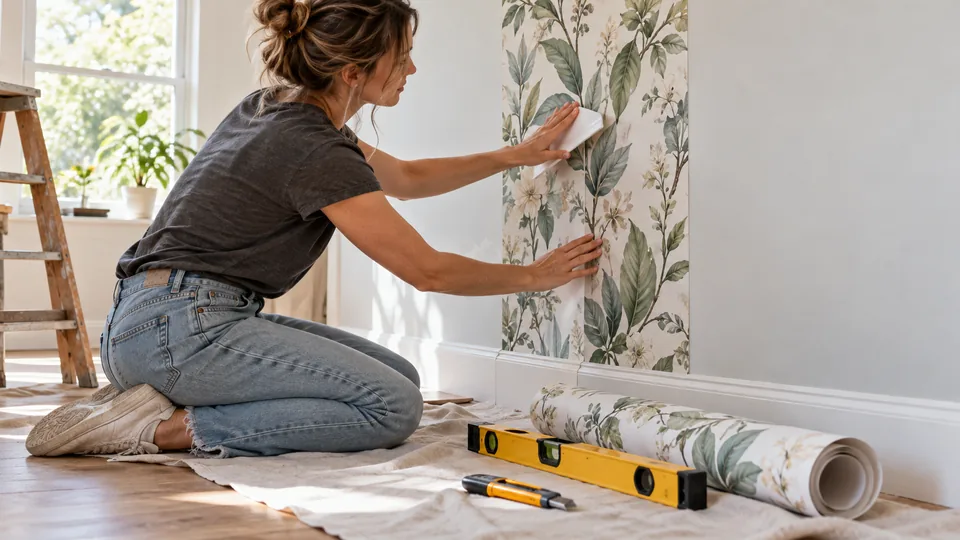
- Mark a plumb line. Measure one roll width minus 1–2 cm from the corner or edge and draw a vertical line with a level. Walls and ceilings are rarely straight, so never use the corner as your guide.
- Cut the first panel. Unroll and cut it to wall height plus 5–10 cm. Note which end is the top of the pattern.
- Peel the top of the liner. Separate only 20–30 cm (8–12 in) of liner from the top. Peeling the whole liner at once is the most common beginner mistake; the film sticks to itself.
- Align and tack. Place the top edge just above the ceiling line with the side edge on your plumb line. Press lightly; most modern adhesives allow repositioning for the first few minutes.
- Smooth from the center out. Work the squeegee in diagonal strokes from the center toward the edges, then pull the liner down another 30 cm and repeat. Keep the liner pulling straight down behind the panel.
- Hang the next panel. Match the pattern and either butt the edges or overlap by the amount printed on the instructions (often 0.5–1 cm). Overlapping hides gaps on uneven walls; butting gives an invisible seam on flat walls.
- Trim. Hold the straightedge in the ceiling and skirting corner and cut the excess with a fresh blade. Cut around outlets after switching off the power and removing cover plates.
- Seal the edges. Go over every seam and edge with firm pressure. Warming the edges with a hairdryer for a few seconds softens the PVC and helps the adhesive flow into the wall surface.
Small air bubbles that remain can be pushed toward an edge or pricked with a pin and pressed flat. For a deeper look at bubble-free technique, see our guide to installing self-adhesive decorative film without bubbles.
Can you put peel-and-stick wallpaper on textured walls?
Can you put wallpaper on textured walls? Yes, but results depend on how deep the texture is. The adhesive only bonds where the film touches, so on heavy texture it sits on the peaks and bridges the valleys. That reduces the contact area and lets the texture show through.
| Wall texture | Typical relief | Peel-and-stick result | Recommendation |
|---|---|---|---|
| Smooth / level 5 finish | Under 0.2 mm | Excellent | Install directly after priming |
| Light orange peel | About 0.2–0.5 mm | Good with thick film | Use embossed or thick vinyl wallpaper for textured walls; press hard and warm edges |
| Heavy orange peel / eggshell texture | About 0.5–1 mm | Fair; texture telegraphs | Skim coat or wall liner first |
| Knockdown, popcorn, stucco | Over 1 mm | Poor; edges lift | Skim coat, or use traditional textured wallpaper with paste |
Does peel-and-stick wallpaper work on textured walls with light orange peel? Usually yes. The best peel-and-stick wallpaper for textured walls (and the best wallpaper for textured walls generally) is thick wallpaper for textured walls with an embossed surface, because the relief pattern hides the wall texture underneath and the thicker PVC film conforms better. Our embossed 3D and silk-texture designs, such as the thick embossed floral textured wallpaper, are made for this.
Wall liner and lining paper for walls
A wall liner (also called liner paper or lining paper for walls) is a plain, heavy paper or non-woven sheet pasted onto a rough wall to create a smooth, paintable base. Heavy-duty liners bridge cracks, paneling grooves and medium texture. Hang lining paper for wallpaper horizontally, let it dry for 24–48 hours, prime it, then apply peel-and-stick on top. For heavy texture, a skim coat of joint compound is more reliable than any liner.
Wall decals for textured walls
Small decals tolerate texture better than full panels because each piece has less area to lift. Use a thicker, more conformable vinyl, press with a cloth-covered fingertip and warm it with a hairdryer so it molds into the texture.
Can you put peel-and-stick wallpaper on wallpaper?
Peel-and-stick wallpaper on wallpaper is possible only when the old paper is smooth, firmly bonded, not vinyl-coated and not textured. Check every seam and corner: if any edge lifts, the new film will pull the old paper off with it. Vinyl-faced old wallpaper is too slick for most self-adhesive films and its own seams will show through.
So can you wallpaper over wallpaper in general? Can you install wallpaper over wallpaper with traditional paste? Yes, using a vinyl to vinyl wallpaper adhesive, but most installers still recommend stripping. Removal plus a coat of primer gives a cleaner, longer-lasting result. Our guide to removing wallpaper without damaging walls explains how.
Peel-and-stick vs prepasted wallpaper vs wallpaper glue
There are three ways to hang wallpaper, and the right one depends on the wall, the room and how permanent you want the result.
| Method | How it sticks | Best for | Removal |
|---|---|---|---|
| Peel-and-stick | Factory PSA on a release liner | Rentals, accent walls, furniture, DIY | Peels off; test first on painted drywall |
| Prepasted wallpaper | Dry paste activated by water | Whole rooms, moderate DIY skill | Steaming or scoring and soaking |
| Unpasted with wallpaper glue | Paste brushed on paper or wall | Heavy vinyl, grasscloth, commercial walls, textured walls with liner | Depends on paper; strippable grades peel dry |
How to use wallpaper paste
For prepasted wallpaper for walls, soak the cut strip in water for the time on the label (often 10–30 seconds), fold it paste-to-paste ("booking") for 3–5 minutes, then hang. For how to hang wallpaper with glue on unpasted paper, roll a thin, even coat of wallpaper adhesive onto the back of the paper or, for "paste the wall" non-woven papers, directly onto the wall. Use the adhesive type the paper specifies: clear or clay-based for heavy vinyl, a non woven wallpaper glue for non-woven paper, and a vinyl wallpaper adhesive glue where vinyl overlaps vinyl.
The best wallpaper glue is simply the one matched to the paper weight and wall. Pre-mixed clay-based adhesives grab hardest; wheat or cellulose pastes are easier to reposition and remove.
How to fix wallpaper seams
Lifting seams are the most common wallpaper repair. For paper or vinyl wallpaper, a wallpaper seam adhesive (seam glue) in a squeeze tube is the fix:
- Lift the loose edge gently with a putty knife.
- Apply a thin bead of wallpaper seam repair adhesive with the nozzle or a small brush.
- Press the seam down with a seam roller and wipe off any squeeze-out with a damp sponge immediately.
- Hold or tape the seam with low-tack painter's tape for an hour while it sets.
For peel-and-stick wallpaper seams, warm the edge with a hairdryer and press it firmly first; that fixes most lifts. If it lifts again, the wall surface is the problem (dust, fresh paint or texture). A tiny amount of seam repair glue under the edge will hold it, but makes later removal harder.
Can you use peel-and-stick wallpaper on furniture and kitchen cabinets?
Yes. Peel and stick wallpaper on furniture, cabinet doors and a kitchen island is one of the most popular small projects, because these surfaces are smooth and usually sealed. Clean with a degreaser, lightly scuff glossy lacquer with a fine abrasive pad, wipe with isopropyl alcohol and wrap edges by at least 1–2 cm (about 0.5 in) to the back.
For high-touch kitchen cabinet doors, a thicker furniture film lasts longer than wallpaper. Our furniture decorative films are 0.5 mm PVC with a 3-year warranty and are made to wrap edges and resist moisture. For vinyl wallpaper kitchen backsplash areas, choose an oil-proof, wipeable grade and keep it away from direct burner heat.
What is the best textured wallpaper?
Textured wallpaper has a raised or embossed surface: grasscloth, linen weave, plaster effect, brick, stone or 3D relief. Self adhesive textured wallpaper gives that depth without paste. Paintable textured wallpaper (often white on white textured wallpaper with an embossed pattern) is a classic way to hide imperfect walls and then paint any color.
Popular choices right now include neutral textured wallpaper in beige, cream, white and grey textured wallpaper for living rooms; green textured wallpaper and blue textured wallpaper for bedrooms and offices; and brown or pink textured wallpaper for warm, modern textured wallpaper for accent wall projects. Luxury textured wallpaper usually means deeper embossing, a silk or pearl sheen, or a fabric-like weave. Textured wallpaper for bathroom walls should be a waterproof, mould-proof PVC grade.
Textured wall panels and 3D textured wall panels are a different product: thicker PVC or foam tiles that add real relief and also hide rough walls. Peel and stick textured wall panels are covered in our guide to 3D wallpaper and 3D wall panels.
Hanging wallpaper tips for retailers and installers
If you sell or install self-adhesive wallpaper, most complaints trace back to three things: unprimed walls, fresh paint and peeling the liner too fast. Printing the plumb-line and "peel 30 cm at a time" steps on the packaging or product page cuts returns noticeably.
For volume work, trade rolls of 0.61 m or 1.22 m × 50 m reduce seams and offcuts compared with 3 m retail rolls. We supply self-adhesive wallpaper and floor films in both formats, with waterproof, mould-proof and fire-retardant grades, MOQ 1 roll for stock designs and 100 rolls for custom prints.
Next step
If you are planning a retail range or an installation project, tell us the wall type, the designs you like and your target roll format. We will send free A4 samples so you can test adhesion on your own walls, plus a quotation within 24 hours. Contact us here.
Frequently Asked Questions
How do you hang peel and stick wallpaper without bubbles?
Prime and clean the wall, then peel only 20 to 30 cm of liner at a time while smoothing the film from the center outward with a felt squeegee. Push any remaining air toward the nearest edge. Small trapped bubbles can be pricked with a pin and pressed flat, and warming edges with a hairdryer improves the final bond.
Does peel and stick wallpaper work on textured walls?
Peel-and-stick wallpaper works on lightly textured walls such as fine orange peel, especially if you choose a thick, embossed vinyl and press it firmly. On heavy orange peel, knockdown, popcorn or stucco texture the adhesive touches only the peaks, so edges lift and the texture shows. Skim coat or line those walls first.
Can you put peel and stick wallpaper over wallpaper?
You can put peel-and-stick wallpaper over old wallpaper only if the old paper is smooth, firmly attached at every seam and not vinyl-coated or textured. Otherwise the new film can pull the old layer off, and old seams will show through. In most cases stripping the old paper and priming the wall gives a far more durable result.
What do you put on walls before wallpapering?
Before wallpapering, clean the wall, fill and sand any defects, and apply a water-based primer or wallpaper primer so the surface is evenly sealed. Rough or cracked walls may also need a lining paper or wall liner. Freshly painted walls should cure for two to four weeks before you apply self-adhesive wallpaper to them.
What is the best wallpaper glue?
The best wallpaper glue is the one matched to the paper and wall. Clay-based pre-mixed adhesive suits heavy vinyl and commercial wallcoverings, cellulose or wheat paste suits lighter papers and is easier to remove, and non-woven papers need a paste-the-wall adhesive. Use a vinyl-to-vinyl adhesive wherever new wallpaper overlaps a vinyl surface.
How do you fix wallpaper seams that are lifting?
Lift the loose edge slightly, apply a thin bead of wallpaper seam repair adhesive underneath, then press it down with a seam roller and wipe away excess glue with a damp sponge. Tape it lightly for an hour while it sets. On peel-and-stick wallpaper, try warming the seam with a hairdryer and pressing hard before using glue.
How hard is it to hang wallpaper?
Hanging peel-and-stick wallpaper is one of the easier decorating jobs: a first-timer can usually finish a 3 to 4 meter accent wall in two to three hours. Pasted wallpaper takes more skill because of soaking, booking and handling wet strips. In both cases, careful wall preparation and a straight plumb line matter more than experience.
Can you put peel and stick wallpaper on cabinet doors?
Yes. Peel-and-stick wallpaper sticks well to clean, sealed cabinet doors, furniture and kitchen islands. Degrease the surface, scuff glossy lacquer lightly, wipe with isopropyl alcohol and wrap the film around edges by 1 to 2 cm. For doors that are handled every day, a thicker 0.5 mm furniture film usually lasts longer than wallpaper.