Key takeaways
- Cabinet refacing keeps the existing cabinet boxes and replaces doors, drawer fronts and hardware while covering the frames in veneer or laminate.
- Refacing typically costs around 30–50% of the price of new cabinets because countertops, plumbing and layout stay in place.
- Wrapping kitchen cabinets in self-adhesive PVC film is the cheapest option, but it changes only the color and texture, not the door profile.
- Water-damaged or swollen particleboard cabinet boxes should be replaced rather than refaced or wrapped.
- Thorough degreasing and a light sanding with 180–220 grit are the most important steps for making veneer or film stick to cabinets.
Cabinet refacing keeps your existing cabinet boxes and replaces the doors and drawer fronts while covering the frames in matching veneer or laminate. It typically costs well under half the price of new cabinets. Replacing tears everything out for a new layout; wrapping covers existing doors and frames in self-adhesive vinyl film and is the cheapest, fastest option.
All three routes can produce a striking before and after kitchen remodel. The right one depends on the condition of your cabinet boxes, whether you want to change the layout, and your budget. This guide compares cost, results, lifespan and disruption, and explains how to reface cabinets yourself with self-stick veneer or film.
What is cabinet refacing?
In kitchen terms, refacing means putting a new face on cabinets that are structurally sound; in the UK, people often call it choosing to reface kitchen cupboards rather than replace them. A typical kitchen cabinet refacing job includes:
- New doors and drawer fronts in a new style, such as shaker, slab or glass-front.
- Veneer or laminate on the face frames and exposed end panels so the boxes match the new doors.
- New hardware: hinges (often concealed soft-close), handles and pulls.
- Optional upgrades such as crown molding, toe kicks, replacement cabinet drawers or pull-out organizers.
The cabinet boxes, countertops, sink and plumbing usually stay in place, so the kitchen stays usable for most of the job. Professional refacing typically takes three to five days for an average kitchen.
How does cabinet refacing work?
The installer removes doors, drawer fronts and hardware, cleans and sands the frames, and bonds a cabinet veneer to every visible surface. Common cabinet refacing materials are wood veneer (a real wood layer about 0.5 mm thick on a paper or fleece backing), rigid thermofoil (RTF) (a PVC film heat-formed over MDF doors), high-pressure laminate (HPL) and self-adhesive PVC decorative film. New doors are then hung and adjusted.
Cabinet refacing vs replacing vs wrapping compared
Costs below are typical ranges for a medium-sized US kitchen and vary widely by region, material and contractor. Use them for relative comparison and get local quotes.
| Factor | Wrapping (vinyl film) | Refacing | Replacing |
|---|---|---|---|
| What changes | Surface color and texture only | Doors, drawer fronts, frame finish, hardware | Everything, including layout and boxes |
| Typical cost | Lowest; DIY materials often a few hundred dollars | Often around 30–50% of new cabinets | Highest; often several times the cost of refacing |
| Time | 1–3 days | 3–5 days | Several weeks including countertops |
| Kitchen usable during work? | Yes | Mostly | No |
| Change door style? | No; same profile | Yes | Yes |
| Change layout? | No | Minor additions only | Yes |
| Typical lifespan | Several years; good PVC film often warrantied for 3 years | 10–20+ years | 15–30+ years |
| DIY friendly? | Very | Possible with kits | Rarely |
The short answer to "reface or replace cabinets?" is: reface if the boxes are solid and you like the layout; replace if the boxes are damaged or the layout does not work; wrap if you mainly want a new color on a tight budget or in a rental.
How much does cabinet refacing cost?
Cabinet refacing cost depends on the number of doors and drawers, the material and your region. In many US markets, professional kitchen cabinet refacing for an average kitchen typically runs in the mid four figures to low five figures, with thermofoil and laminate at the lower end and solid-wood doors with real wood veneer at the higher end.
Contractors often price refacing per door, with drawer fronts and linear feet of face frame added. Main cost drivers:
- Door count. A kitchen with 30 doors and drawers costs roughly half as much as one with 60.
- Door material. Thermofoil and laminate cabinet doors cost less than solid wood or painted MDF shaker doors.
- Veneer type. PVC film and laminate cost less than wood veneer; stained hardwood veneer costs the most.
- Extras. Soft-close hinges, new drawer boxes, glass inserts and crown molding add up quickly.
Online cabinet refacing cost calculators multiply door count by a regional per-door rate. They are useful for a first estimate, but measure your own doors and get two or three quotes before you budget.
Cost of new cabinets and replacing kitchen cabinets
The cost of new cabinets includes demolition, the cabinets themselves, installation and usually new countertops, because old tops rarely survive removal. Stock cabinets are the cheapest; semi-custom and custom add more. Plumbing, electrical and flooring changes often follow, so a full replacement typically costs several times more than refacing the same kitchen.
Cost of wrapping kitchen cabinets
Wrapping uses self-adhesive decorative film over existing doors and frames. Materials for a DIY wrap of a small to medium kitchen are often in the low hundreds of dollars; professional wrapping costs more but still well below refacing. It is the cheapest way to reface kitchen cabinets visually, though the door profile does not change.
Can you just replace kitchen cabinet doors?
Yes. Replacing kitchen cabinet doors only is a middle path: you order new cabinet doors on old cabinets and paint or wrap the frames to match. It works when the frames are in good condition and the existing hinge positions suit the new doors.
- Shaker cabinet door replacement is the most popular style change, from raised-panel oak to flat-center shaker.
- Replacement cabinet doors with glass suit upper cabinets either side of a range hood or window.
- Cabinet drawer replacement covers new drawer fronts or complete drawer boxes with full-extension runners.
- Specialty doors, such as a lazy Susan cabinet door replacement, replacement sliding cabinet doors or medicine cabinet door replacement, are usually made to measure.
Measure each door's width and height, overlay and hinge type (concealed or exposed) before ordering. For an overview of door styles, see our guide to types of kitchen cabinet doors.
Cabinet refacing materials: wood veneer, laminate and vinyl film
| Material | What it is | Strengths | Limitations |
|---|---|---|---|
| Wood veneer | Real wood sliced to about 0.5 mm, on paper or self-stick backing | Authentic grain; can be stained and finished | Needs finishing; more skill to apply |
| High-pressure laminate (HPL) | Resin-impregnated paper layers, about 0.7–1 mm | Very hard-wearing; wide color range | Rigid; needs contact cement and edge banding |
| Rigid thermofoil (RTF) | PVC heat-formed over MDF doors | Seamless, wipeable doors | Can peel near heat sources such as ovens |
| Self-adhesive PVC film | Printed PVC with pressure-sensitive adhesive, about 0.12–0.5 mm | Fast, DIY friendly; wood grain, marble, matte and gloss | Same door profile; edges need careful wrapping |
Veneer cabinets and wood veneer kitchen cabinets look the most like solid wood. Laminate cabinet refacing and PVC film are easier to keep clean and suit modern flat-panel looks. Our furniture decorative film range includes 0.5 mm self-adhesive PVC in wood grain, marble and solid matte or high-gloss finishes on 1.22 m × 50 m rolls, with a 3-year warranty.
How do you reface cabinets yourself?
DIY cabinet refacing with self-stick veneer or decorative film is realistic for a patient DIYer with basic tools: a felt-edged squeegee, a sharp utility knife with snap-off blades, a heat gun, a straightedge and a drill. Work at room temperature, ideally 18–25 °C (65–77 °F).
- Empty and assess the cabinets. Remove contents, doors, drawers and hardware. Check that boxes are square, dry and solid; swollen particleboard or water damage means replacement, not refacing.
- Clean and degrease every surface. Wash frames and doors with a degreasing cleaner, rinse and let dry for 24 hours. Kitchen grease is the most common reason film or veneer lifts.
- Repair and sand. Fill dents and old hardware holes you will not reuse, sand glossy finishes lightly with 180–220 grit and vacuum the dust.
- Prime porous or problem surfaces. Apply an adhesion primer to raw MDF, particleboard edges or chalky paint so the adhesive bonds evenly.
- Cover the face frames and end panels. Cut self-stick veneer or film strips about 10 mm oversize, apply with a felt squeegee and trim flush with a sharp blade.
- Wrap doors and drawer fronts. Lay each door face down on the film, cut with a 20–30 mm margin, smooth from the center out and fold edges around, warming curves with a heat gun at low setting.
- Trim, reinstall and adjust. Cut out hinge cups and handle holes, reinstall doors with new hinges if needed, adjust gaps and fit new handles.
For bubble-free application technique, read our guide on how to install self-adhesive decorative film. If you are comparing cheaper liners with thicker films, see contact paper vs vinyl wrap for kitchen cabinets.
Is cabinet refacing worth it?
Refacing is worth it when the cabinet boxes are solid wood or plywood, the layout works and you want a new door style. The benefits of cabinet refacing are lower cost, less waste, no new countertops and a usable kitchen during the work. It is less worthwhile when boxes are water-damaged particleboard, when you want to move the sink or add an island, or when the total refacing quote approaches the price of stock cabinets.
The same logic applies to refacing a bathroom vanity: a small vanity can often be refaced or wrapped in a day, but a vanity with a swollen base from leaks should be replaced.
Cabinet refacing before and after: what changes most
The most dramatic kitchen renovation before and after results come from changing color and door style together. Common transformations:
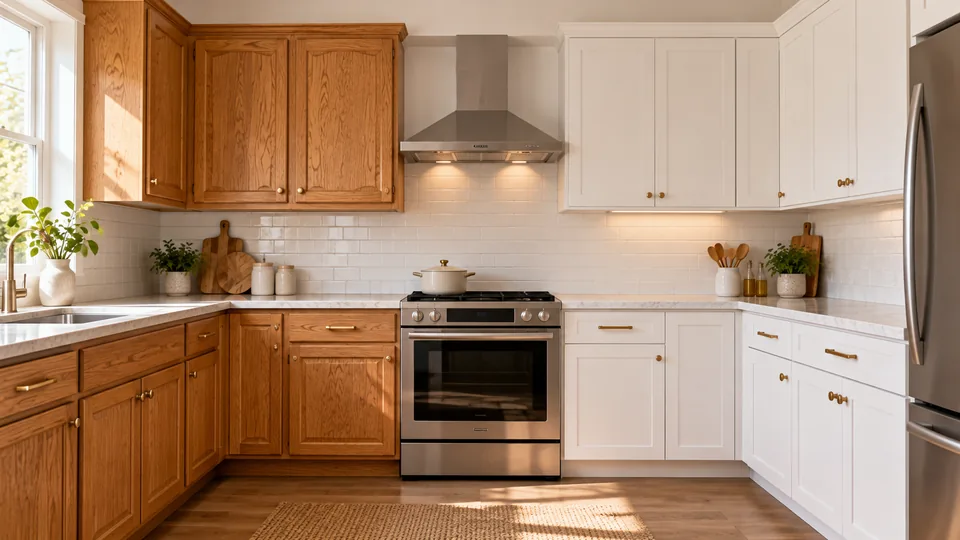
- Honey oak cabinets before and after: oak raised-panel doors become white or sage shaker doors, or the oak frames are wrapped in a matte solid color.
- Adding trim to flat cabinet doors: thin strips glued to slab doors create a shaker look before painting or wrapping.
- Before and after wrapped kitchen cabinets: dated cream laminate turns into walnut wood grain or grey stained oak look in a weekend.
- White kitchen cabinets before and after: yellowed white thermofoil is refaced with new doors or high-gloss white film.
For more ideas that keep the existing boxes, see how to update old kitchen cabinets without replacing them.
For refacing contractors, franchises and distributors
Professional kitchen cabinet refacing businesses need consistent film color across repeat orders and an adhesive matched to common door substrates. Our kitchen cabinet refacing case study describes how wood grain and solid-color furniture film is sampled on the actual door and edge profile before production. We supply stock colors from 1 roll and custom colors or embossing from 100 rolls, with 15–25 day lead times on custom orders.
Next step
Send us photos of the doors you want to cover, the finish you are after (wood grain, marble, matte or gloss) and your estimated roll quantity. We will send free A4 samples and a quotation within 24 hours. Request samples here.
Frequently Asked Questions
What is cabinet refacing?
Cabinet refacing is a kitchen update that keeps the existing cabinet boxes but replaces the doors and drawer fronts, covers the face frames and end panels with matching wood veneer, laminate or film, and adds new hinges and handles. Countertops, sinks and plumbing stay in place, so the kitchen remains usable.
How much does cabinet refacing cost?
Cabinet refacing cost depends on door count, materials and region. In many US markets, professional refacing for an average kitchen typically runs from the mid four figures to the low five figures, often around 30 to 50 percent of new cabinets. Thermofoil and laminate cost less than solid-wood doors and wood veneer.
Is it cheaper to reface or replace cabinets?
Refacing is usually much cheaper than replacing because the cabinet boxes, countertops and plumbing stay in place and there is no demolition. Replacing makes sense only when the boxes are damaged or you want a new layout. Wrapping existing doors in vinyl film is cheaper than either option.
Can you just replace kitchen cabinet doors?
Yes. You can order new cabinet doors and drawer fronts for existing boxes and paint or wrap the face frames to match. Measure each door's width, height, overlay and hinge type carefully. Shaker and glass-front replacement doors are popular choices for updating a kitchen without full refacing.
How long does cabinet refacing last?
Professionally refaced cabinets with quality wood veneer or laminate typically last 10 to 20 years or more, depending on use and care. Self-adhesive PVC film wraps usually last several years; good furniture films are often warrantied for three years. Heat from ovens and steam from kettles shorten the life of any finish.
Can I reface cabinets myself?
Yes. DIY cabinet refacing with self-stick veneer or decorative film is achievable with a squeegee, sharp utility knife, heat gun and straightedge. The keys are thorough degreasing, light sanding, priming porous surfaces and careful edge wrapping. Ordering ready-made replacement doors avoids the hardest part of the job.
Is cabinet refacing worth it?
Cabinet refacing is worth it when the boxes are solid wood or plywood, the layout works and you want a new door style for less than new cabinets. It is not worth it if boxes are water-damaged, you want to change the layout, or the refacing quote approaches the cost of stock cabinets.