Key takeaways
- Commercial vinyl wallcovering is a PVC face laminated to a fabric, non-woven or paper backing and hung with wallcovering adhesive.
- Type II vinyl, about 13–22 oz per square yard, is the standard choice for hotel corridors, lobbies and restaurants.
- US hotel corridors and exits usually require Class A wallcoverings under ASTM E84, with flame spread of 0–25.
- Solid vinyl acts as a vapor retarder, so exterior walls in hot, humid climates need a breathable or perforated wallcovering.
- Ordering 5–10% extra from the same batch as attic stock makes future repairs match.
Commercial vinyl wall covering is the default wall finish in hotels because it is scrubbable, impact resistant, fire rated and available in almost any color or texture. Specify Type II vinyl for corridors, lobbies and public areas, Type I or lighter Type II for guestrooms, and confirm a Class A fire rating and moisture strategy before ordering.
Hotel walls take more abuse than almost any other interior: luggage carts, cleaning chemicals, humidity from bathrooms and constant guest traffic. Hospitality design teams also need finishes that look high end and can be replaced quickly between renovations. This guide covers wallcovering types and weights, fire and durability requirements, how vinyl compares with fabric wall coverings, installation and adhesives, design trends, and what to send a factory when you source commercial wallcovering for a project.
What is commercial vinyl wall covering?
Commercial vinyl wallcovering is a PVC (polyvinyl chloride) film laminated to a backing, usually woven fabric (scrim), non-woven polyester-cellulose or paper. The PVC face carries the print and emboss; the backing gives dimensional stability and tear strength. It is sold in wider rolls than residential wallpaper, commonly 1.22–1.37 m (48–54 in) wide, and installed with wallcovering glue.
Commercial vinyl wallpaper, sometimes listed as commercial wall paper or vinyl wall covering commercial grade, differs from residential wallpaper in weight, durability testing and fire certification. The North American classification, based on a long-standing federal specification, groups products by total weight:
| Type | Total weight | Durability | Typical hotel use |
|---|---|---|---|
| Type I (light duty) | About 7–13 oz/yd² (240–440 g/m²) | Light abrasion, washable | Guestrooms, offices, low-traffic areas |
| Type II (medium duty) | About 13–22 oz/yd² (440–750 g/m²) | Scrubbable, resists scuffs and carts | Corridors, lobbies, restaurants, elevator lobbies |
| Type III (heavy duty) | Over 22 oz/yd² (over 750 g/m²) | High impact | Service corridors, back of house, loading areas |
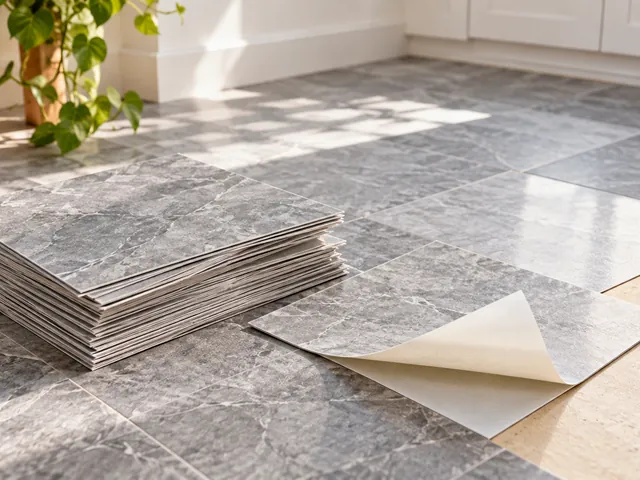
Self-adhesive PVC wallpaper is a lighter alternative used for fast refurbishments, accent walls and furniture faces, where downtime matters more than maximum impact resistance.
What wall covering options suit each hotel area?
Wall covering options differ by zone, and most hotels use several. A typical specification:
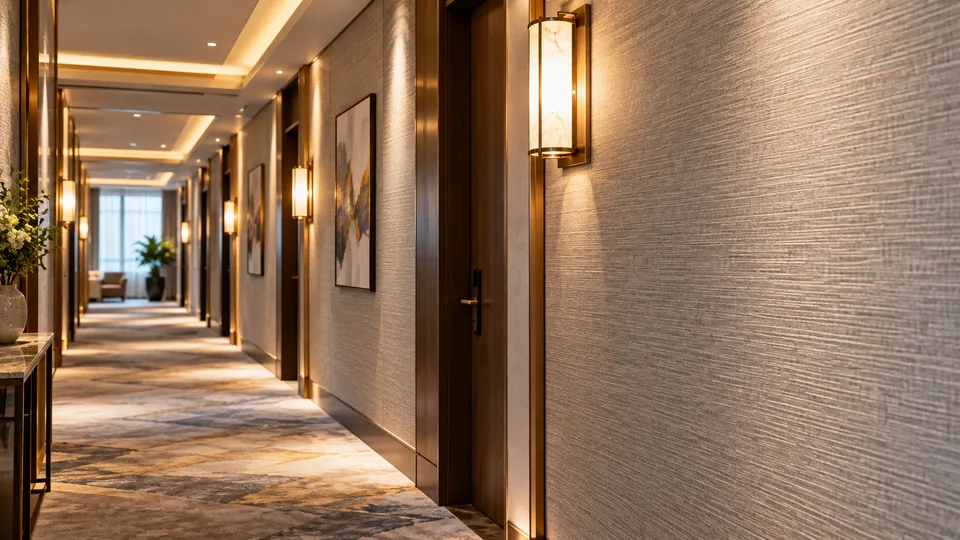
- Lobby and reception: high end wallcoverings with strong texture, metallic or bespoke prints, often Type II vinyl, or fabric wall coverings on feature walls out of reach.
- Guest corridors: Type II vinyl with a busy or textured pattern that hides scuffs; corner guards at turns.
- Guestrooms: hotel room design interior schemes usually call for Type I or light Type II vinyl, or self-adhesive PVC on headboard walls for quick changes.
- Guest bathrooms: vinyl wall covering for bathrooms outside wet zones, with good ventilation; tile or panels inside showers.
- Restaurants and bars: commercial wallpaper for restaurants must be scrubbable and grease tolerant; textured vinyl or murals are common.
- Meeting rooms and ballrooms: fabric or acoustic wallcoverings to reduce echo, or vinyl with a fabric look.
Our hotel guestroom project and hotel lobby project show how self-adhesive films are used in these spaces.
Vinyl wall covering vs fabric wall coverings
Fabric wall covering, also called cloth wall covering or textile wallcovering, uses woven fabric, linen, silk, wool or grasscloth as the face. It looks and feels soft, absorbs sound and is popular in luxury suites and lounges. Vinyl is tougher and easier to clean.
| Property | Vinyl wallcovering | Fabric for wallcovering |
|---|---|---|
| Cleanability | Scrubbable with mild detergent | Vacuum or spot clean; stains easily |
| Impact and abrasion | High, especially Type II and III | Low to medium |
| Look and feel | Any print or emboss, including fabric and stone looks | Natural texture and depth |
| Acoustics | Limited | Better sound absorption |
| Moisture | Water resistant face; vapor retarder | Absorbs humidity |
| Cost | Lower | Higher |
Many designers use fabric wall coverings in low-touch areas and a fabric-look textured wall covering in vinyl wherever guests and staff touch the walls.
What fire and performance ratings do hotels need?
Requirements depend on local codes and the brand standard, but the most common requests are:
- Fire rating. In the US, wallcoverings in corridors and exits usually need a Class A rating under ASTM E84 (flame spread 0–25, smoke developed 450 or less). In Europe, ratings are given under EN 13501-1, for example B-s1,d0. Ratings apply to the product as tested on a specific substrate.
- Washability and scrubbability. Ask for test results showing how many scrub cycles the surface withstands.
- Colorfastness. Light-fastness testing shows resistance to fading near windows.
- Mold and mildew resistance. Important in coastal and tropical hotels.
- Low emissions. Many projects require low-VOC products for indoor air quality.
Always request the actual test report for the exact product, not a general brochure. We supply CE and SGS test reports and offer fire-retardant grades; our quality and testing page lists inspection stages.
The moisture problem in hot, humid climates
Solid vinyl is a vapor retarder. On exterior walls of air-conditioned hotels in hot, humid climates, warm moist air can pass through the wall from outside and condense behind the vinyl, causing mold. Designers handle this with breathable or micro-perforated wallcoverings on exterior walls, proper wall assembly design and mildew-resistant adhesives. Raise this early with the architect and mechanical engineer.
How is commercial wallcovering installed?
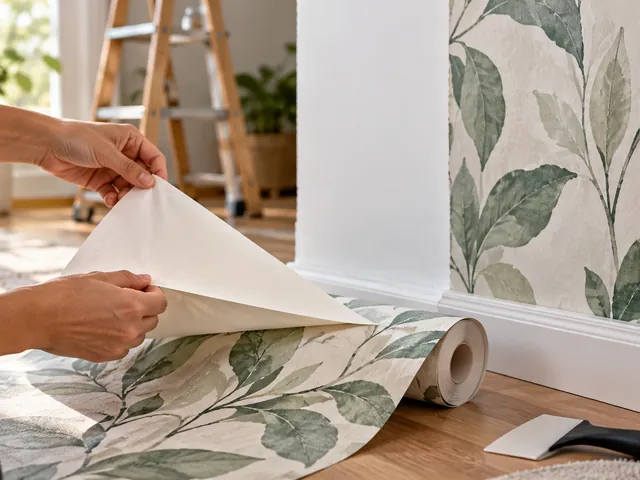
Commercial wall covering rolls are hung by professional installers using wallcovering adhesive. A standard process:
- Prepare the wall. Repair, skim and sand drywall to a smooth finish, then apply a wallcovering primer so the paper can be stripped later without damaging the board.
- Acclimatize materials. Store rolls in the conditioned space for 24–48 hours, ideally at 18–25 °C (65–77 °F).
- Check batches. Confirm that all rolls carry the same run or batch number to avoid shade differences.
- Apply adhesive. Use the wallcovering glue recommended by the manufacturer, usually a heavy-duty clear or clay-based vinyl adhesive with mildew inhibitor, applied to the back or the wall.
- Hang and double-cut seams. Overlap seams, then cut through both layers with a straightedge for an invisible joint. Many wide commercial vinyls are reverse-hung, with every other drop turned 180°.
- Smooth and clean. Remove air and excess adhesive, and wipe glue off the face immediately with clean water.
Self-adhesive PVC wallcovering skips the glue step, which shortens room downtime during renovations. Our guide to self-adhesive wallpaper for hotels and rentals explains when it is the better choice.
Hotel design trends in wallcovering
Hospitality interior design moves quickly, and wallcoverings are one of the easiest ways for hotels to signal a refresh. Current hotel design trends include:
- Texture over pattern: plaster, linen, grasscloth and stone looks in vinyl that read as natural materials.
- Biophilic and local themes: botanical murals and landscapes tied to the location.
- Black and gold wallcovering and other metallic accents in bars, lifts and powder rooms.
- Bespoke wall coverings and custom commercial wallpaper printed with brand motifs or local art.
- Commercial wall murals at reception desks and in restaurants as photo-friendly features.
Hotel room design trends favor calm, textured headboard walls with a single feature finish rather than wall-to-wall patterns, which also keeps replacement costs down. Modern wallcovering design increasingly blurs the line between wallpaper, panels and art.
How much wallcovering does a hotel project need?
Commercial quantities are calculated by linear meter or yard rather than by single roll. A practical method for estimating each wall covering roll requirement:
- Measure net wall area per zone. Multiply wall length by height for corridors, rooms and public areas, then subtract large openings such as doors and windows.
- Divide by usable roll width. For a 1.37 m (54 in) commercial roll, divide the total wall length by 1.37 to get the number of drops, then multiply by wall height plus 10 cm (4 in) trim allowance.
- Add pattern repeat. For patterned designs, add one repeat length to each drop.
- Add waste and attic stock. Add about 10% for waste, plus 5–10% attic stock from the same batch.
For self-adhesive rolls, the calculation is simpler: a 1.22 m × 50 m roll covers about 61 m² (roughly 656 sq ft) before waste. On a typical guestroom headboard wall of 3.5 m × 2.7 m, one roll covers about six rooms after trimming.
Interior design for hotels: who specifies what
Interior design in hospitality industry projects usually involves several parties. A hospitality design agency or one of the hotel interior design firms creates the concept and finish schedule; the brand standards team approves it; the architect checks code compliance, including fire ratings and hospitality architecture details such as wall assemblies; and the general contractor or a purchasing agent buys and installs the materials. Commercial and hospitality interior design teams rely on manufacturers for samples, data sheets, test reports and lead-time guarantees, so having those ready speeds up approval. Owners searching for the best hospitality interior design firms often judge them partly on how well they manage these material submittals.
For hospitality design firms and contractors: sourcing from a factory
Hospitality interior design firms and hotel design firms usually specify the look, while contractors and procurement agents buy the material. When sourcing commercial wallcovering directly from a manufacturer:
- Send the design intent, the area per zone and the required fire rating and test standard.
- Request strike-offs (production samples) for custom prints and approve color before the run.
- Order 5–10% extra as attic stock for future repairs, from the same batch.
- Agree on roll format, packaging and labeling by room or floor.
We produce self-adhesive PVC wallcoverings in 0.61 m or 1.22 m × 50 m trade rolls with waterproof, mould-proof and fire-retardant grades, and custom designs from 100 rolls with 15–25 days lead time. See our OEM and ODM services for custom work.
Next step
Send us the project type, wall areas by zone, design references and required fire and test standards. Contact us for free A4 samples, test reports and a quotation within 24 hours.
Frequently Asked Questions
What is commercial vinyl wall covering?
Commercial vinyl wall covering is a PVC surface laminated to a fabric, non-woven or paper backing, made for hotels, offices, hospitals and retail. It is heavier and more durable than residential wallpaper, scrubbable, available in wide rolls and tested for fire performance. It is usually classified as Type I, II or III by weight.
What is the difference between Type I and Type II wallcovering?
Type I wallcovering weighs about 7 to 13 ounces per square yard and suits low-traffic areas such as guestrooms and offices. Type II weighs about 13 to 22 ounces per square yard, resists scuffs and scrubbing better, and is the standard for hotel corridors, lobbies, restaurants and other public areas.
Is vinyl wallpaper good for hotels?
Yes. Vinyl is the most common wall finish in hotels because it is scrubbable, resists impacts from luggage and carts, tolerates cleaning chemicals and is available with fire ratings. It also reproduces textures such as linen, plaster and stone at a lower cost and with less maintenance than natural materials.
What fire rating do hotel wallcoverings need?
Requirements vary by code and location, but in the US hotel corridors and exits usually need Class A wallcoverings tested to ASTM E84, meaning flame spread of 0 to 25 and smoke developed of 450 or less. In Europe, products are classified under EN 13501-1. Always request the test report for the exact product.
What glue is used for commercial wallcovering?
Commercial vinyl is usually hung with a heavy-duty premixed vinyl wallcovering adhesive, either clear or clay-based, containing a mildew inhibitor. The wall should be primed with a wallcovering primer first so the material can be stripped later. Self-adhesive PVC wallcoverings need no glue, which shortens installation time.
Is fabric wall covering better than vinyl?
Fabric wall covering offers natural texture and better sound absorption, so it suits luxury suites, lounges and meeting rooms. Vinyl is more durable, scrubbable and cheaper, so it is better for corridors, guestrooms and restaurants. Many hotels combine both, using fabric in low-touch areas and fabric-look vinyl elsewhere.
Can vinyl wall covering cause mold?
It can on exterior walls of air-conditioned buildings in hot, humid climates. Solid vinyl acts as a vapor retarder, so moist air passing through the wall can condense behind it. Breathable or micro-perforated wallcoverings, correct wall assembly design and mildew-resistant adhesive prevent the problem.