Key takeaways
- Stained glass window film is translucent printed PVC or PET, typically 100–200 micron, that imitates colored leaded glass on ordinary panes.
- Static cling stained glass film holds without adhesive and is reusable, while adhesive film stays flatter on large or humid windows.
- Rainbow, iridescent and dichroic films create color through thin-film interference and offer little privacy on their own.
- The wet application method with a slip solution and center-out squeegeeing gives the most bubble-free result.
- Dark decorative films absorb heat, so check glass guidance before applying them to large tempered or double-glazed panes in direct sun.
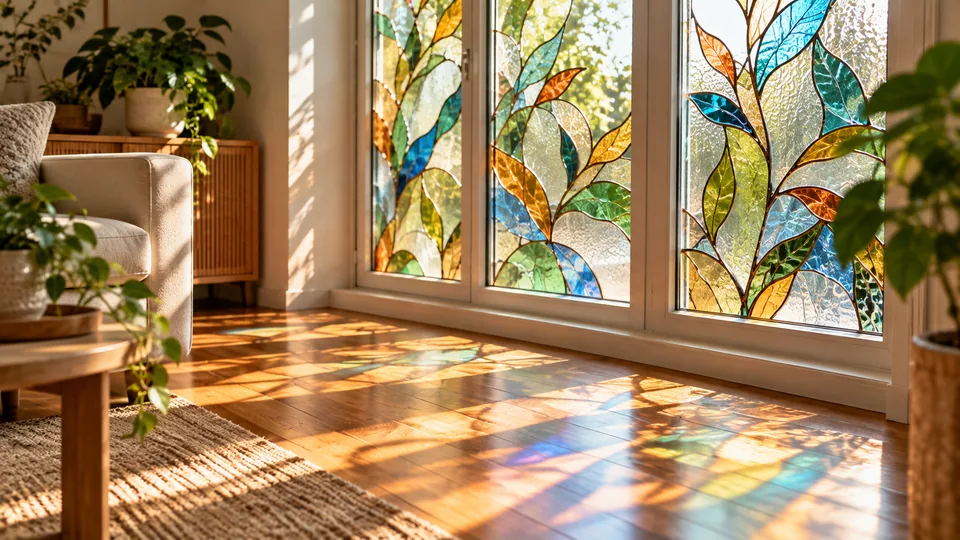
Stained glass window film is a translucent printed vinyl that you apply to ordinary glass to imitate colored, leaded stained glass. It filters light into color, adds partial privacy and installs with water or static cling in under an hour per window. It costs a small fraction of real stained glass and removes without damaging the pane.
It is one of several types of decorative window film. This guide explains the main styles, from faux stained glass and reeded glass film to rainbow prism film and custom window decals, where each works best, and how to install them without bubbles.
What is stained glass window film?
Most stained glass window film is a 100–200 micron (4–8 mil) PVC or polyester (PET) film printed with transparent inks. Light passes through the color, just as it does through real cathedral glass. Better films add a raised, embossed texture or printed dark "lead lines" so the design reads as faux leaded glass even up close.
There are two ways the film holds to glass:
- Static cling: no adhesive; a soft, plasticized PVC film holds by surface tension and static. Stained glass window clings are fully reusable and ideal for rentals.
- Adhesive: a thin, clear pressure-sensitive adhesive (PSA) bonds the film. Peel and stick stained glass is more permanent, stays flatter on large panes and resists edge lifting in humid rooms.
Compared with real stained glass, film is lighter, cheaper and DIY friendly, but it does not have the depth and hand-made variation of genuine glass. From a few meters away, a good vintage stained glass window film or 3D stained glass window film with embossing is very convincing.
Types of decorative window film
| Type | What it looks like | Privacy | Best uses |
|---|---|---|---|
| Stained glass film | Colored, translucent designs with lead lines; floral, geometric, art deco | Partial | Front doors, transoms, stair windows, bathrooms |
| Frosted and etched film | Uniform sandblasted look, plain or patterned | High (daytime) | Bathrooms, offices, conference rooms |
| Reeded glass film / fluted glass film | Vertical ribbed texture that blurs the view | Medium to high | Cabinet doors, shower screens, interior partitions |
| Rainbow, iridescent and dichroic film | Clear film that throws rainbows and shifts color with angle | Low | Sunny windows, kids' rooms, retail displays |
| Prism window film | Faceted clear film that splits sunlight into spectrum | Low | South-facing windows, suncatchers |
| Gradient film | Frosted fading to clear | Variable | Offices, street-facing windows |
| Geometric window film | Frosted or tinted patterns: lines, grids, hexagons | Partial | Modern homes, glass partitions |
| Window decals and vinyl window graphics | Cut or printed letters, logos and shapes | Low | Storefronts, cars, signage |
Our decorative frosted office glass film is an example of the frosted, etched and patterned category: PVC at 120, 140 or 160 micron in widths from 0.61 to 1.52 m, rated for 3–5 years indoors.
Stained glass window clings vs adhesive stained glass film
Choose static cling when you want to reposition the design, take it with you when you move, or use it on a window for a season. Stained glass window cling film is also the safest option on very old, fragile glass.
Choose adhesive vinyl stained glass window film when the pane is large, the room is humid such as a bathroom, or you want a long-term finish on a front door or sidelight. Adhesive films usually stay flatter and are less likely to collect dust behind the edges. We compare the two in detail in static cling vs adhesive window film.
Best decorative window film patterns for modern homes
Pattern choice depends on the architecture and how much privacy you need:
- Reeded and fluted: the most popular modern look. Reeded window film on glass cabinet doors or a shower screen gives a boutique-hotel effect and hides clutter.
- Stained glass window film art deco designs: fan shapes, sunbursts and stepped geometry suit 1920s and 1930s homes and modern interiors with brass and black accents.
- Floral stained glass window film: suits Victorian and cottage-style homes, transom windows and stair landings.
- Clear stained glass windows: textured clear designs with beveled-look panes add sparkle without color, ideal for minimal interiors.
- Geometric and satin glass pattern films: fine lines or grids suit offices and modern bathrooms.
Stained glass for door windows and sidelights
Front door decorative glass inserts are expensive to replace. Applying stained glass for door window panels and sidelights gives a similar effect at much lower cost and adds privacy from the street. Apply the film to the interior face of the glass, and for doors with textured or beveled glass, test adhesion first, because film only bonds fully to smooth glass. The same approach works for decorative glass exterior door inserts that look dated: cover them from the inside rather than replacing the door.
Stained glass stickers and decals vs full-pane film
Not every window needs edge-to-edge coverage. Stained glass window decals and stained glass stickers for windows are smaller, pre-cut motifs, such as a rose, a sunburst or a border, that you apply to part of the pane. A single stained glass window sticker in a corner is a quick way to add color to decorative windows without losing the view. Stained glass decals are usually static cling or removable adhesive, so they suit renters and seasonal decorating.
Full-pane faux stained glass window film, sometimes sold as fake stained glass window film or stained glass vinyl, covers the whole glass and gives a more convincing, built-in look. As decorative window treatments ideas go, it also replaces curtains on small windows where fabric would block too much light.
Rainbow, iridescent and dichroic window film explained
Rainbow window film and iridescent window film are clear PET films coated with many ultra-thin layers. Light reflecting between the layers interferes and separates into colors that shift as you move. This is the same principle as dichroic glass, which is why the products are also called film dichroic or dichroic window film. They reflect one color and transmit its complement, so a window can look blue from outside and amber inside.
Prismatic window film works differently: it has a molded, faceted surface that bends sunlight like a prism, throwing small rainbows across the room. Rainbow prism window film and prism window cling products are popular in kids' rooms and sunny kitchens. Neither type gives much privacy; for that, choose a rainbow privacy film that combines an iridescent layer with frosting.
How to install stained glass window film
The wet method gives the best results for both adhesive and static cling film. Allow 30–60 minutes per average window.
- Clean the glass. Scrape off paint specks with a razor blade, then wash with soapy water and a lint-free cloth. Clean the frame edges too.
- Measure and cut. Measure the visible glass and cut the film 1–2 cm (1/2 in) larger on every side. Align the pattern so lead lines run true to the frame.
- Mix a slip solution. Fill a spray bottle with water and a few drops of baby shampoo.
- Wet the glass and the film. Spray the glass generously, peel the liner and spray the adhesive or cling side.
- Position and squeegee. Lay the film on the glass, slide it into place, then squeegee from the center outward to push out water and air.
- Trim the edges. Run a sharp blade along the frame, leaving a gap of about 1–2 mm, then squeegee the edges again with a cloth-wrapped squeegee.
- Let it cure. Haze and small water pockets disappear in a few days to two weeks, depending on temperature. Do not clean the film for a week.
For removal and troubleshooting, see how to install and remove window film.
Window decals, window stickers and window graphics for businesses
Window decals and window stickers are cut or printed vinyl designs rather than full-pane film. Custom window decals and custom window stickers cover store hours, logos, menus and promotions, while vinyl storefront window graphics turn the glass into signage. Key choices:
- Cut vinyl vs printed: plotter-cut vinyl window decals and vinyl window stickers in solid colors are crisp and long-lasting; printed decals handle photos and gradients.
- Inside or outside: exterior window decals face the weather and need outdoor-rated vinyl; decals applied inside, reading through the glass, last longer and are protected from scraping.
- See through window graphics: perforated vinyl shows a full image outside while letting people see out.
- Removable vs permanent adhesive: removable for seasonal promotions and window decals for home; permanent for long-term signage, office window decals and custom rear window decals on vehicles.
The best vinyl for window decals is usually an 80–100 micron calendered or cast vinyl with a matching adhesive; our cutting vinyl buyer's guide explains permanent vs removable grades in depth.
Does decorative window film give privacy?
Stained glass privacy window film blocks clear views during the day because the printed color and texture scatter light. At night, with lights on inside, shapes and movement are still visible through lighter designs, so add blinds where full night privacy matters. Frosted and reeded films give the most privacy of the decorative styles.
Two safety notes: dark or heavily colored films absorb heat, so check the glass manufacturer's guidance before applying them to large double-glazed or tempered glass panes in direct sun, where thermal stress can crack glass. And keep film off the outer surface of insulated units unless the product is rated for exterior use.
For retailers, sign shops and installers
We manufacture frosted, etched and patterned PVC glass film in 120–160 micron thicknesses, 0.61, 0.92, 1.22 and 1.52 m widths and 50 or 100 m rolls, plus plotter-cut graphic and signage vinyl in 80–200 micron for window decals and storefront lettering. The office glass film case study shows patterned film laid out in bands on glazed partitions. Stock rolls ship from 1 roll in 7–10 days; custom patterns and private-label packaging start at 100 rolls.
Next step
Tell us the film style (frosted, patterned or cut vinyl), width, thickness, adhesive type and quantity, or send a photo of the glass you want to decorate. We will send free A4 samples and quote within 24 hours. Request samples or a quotation.
Frequently Asked Questions
Is stained glass window film easy to remove?
Yes. Static cling stained glass film peels off by hand and can be reused. Adhesive stained glass window film usually removes cleanly if you lift a corner and peel slowly at a low angle; warming it with a hairdryer helps. Any remaining adhesive residue comes off glass with soapy water, a plastic scraper or isopropyl alcohol.
Does stained glass window film provide privacy?
Stained glass window film gives partial privacy. During the day, the printed color and texture blur the view from outside. At night, with interior lights on, shapes and movement can still be seen through lighter or more transparent designs. For full privacy, choose a darker or frosted-backed design, or combine the film with blinds or curtains.
Can you put stained glass film on a front door?
Yes, front doors and sidelights are among the most popular places for stained glass film. Apply it to the interior face of smooth glass using the wet method. Film will not bond fully to heavily textured or beveled glass, so test a small piece first, and check the door glass guidance before using dark films in strong sun.
What is the difference between static cling and adhesive window film?
Static cling window film has no glue and holds to smooth glass by surface tension, so it is reusable and ideal for renters. Adhesive window film uses a thin clear pressure-sensitive adhesive that bonds more firmly, stays flatter on large panes and resists lifting in humid rooms, but it is designed to stay in place longer.
How long does decorative window film last?
Indoor decorative window film typically lasts 3 to 5 years or longer when applied to the inside of the glass and cleaned with mild soap and a soft cloth. Strong direct sunlight fades printed colors faster, and abrasive cleaners scratch the surface. Exterior-rated films are needed if the film is applied to the outside of a window.
What is reeded glass film?
Reeded glass film is a clear or frosted decorative window film embossed with narrow vertical ribs that imitate reeded or fluted glass. The ribs distort the view through the glass while letting light pass, which gives medium to high privacy. It is popular on kitchen cabinet doors, shower screens, interior partitions and bathroom windows.
What is the best vinyl for window decals?
For most window decals, use an 80 to 100 micron calendered or cast vinyl with an adhesive matched to the job. Removable adhesive suits seasonal promotions and home windows, while permanent adhesive suits long-term storefront lettering and vehicle decals. Exterior decals need outdoor-rated vinyl; decals applied inside the glass are protected from weather and scraping.