Key takeaways
- Frosted privacy film blocks a clear view through glass while still letting most daylight through, which is why it is the most common fix for glass front doors and sidelights.
- Self-adhesive decorative film should be applied to the smooth interior face of the glass; it will not bond properly to heavily textured or patterned glass.
- Decorative frosted PVC window film is typically 0.10–0.16 mm thick, while dedicated safety and security films are much thicker polyester laminates designed to hold broken glass in place.
- Sliding glass doors are best handled with film on the lower part of the glass or a full frosted panel, because shades and curtains get in the way of a door that opens daily.
- Static cling film holds by surface tension rather than adhesive, so it suits renters and seasonal use, while adhesive film lasts longer on doors that are opened and cleaned often.
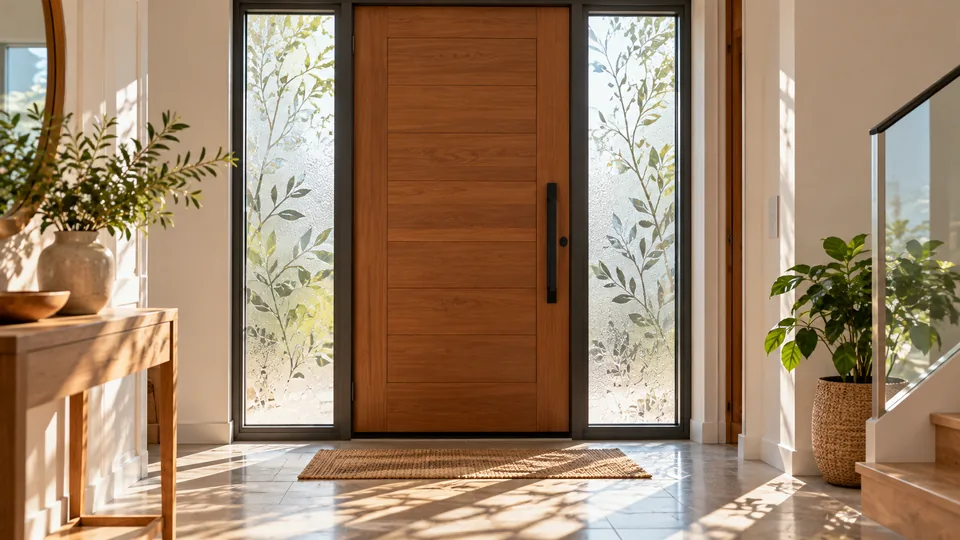
The simplest way to get glass front door privacy without losing daylight is a frosted or decorative window film applied to the inside of the glass. It blurs the view from the porch, keeps the entry bright, costs far less than replacement glass and installs on a front door, sidelight, patio door or shower door in about an hour.
This guide compares the main front door window coverings, explains how to choose film for sidelights and sliding doors, and gives a step-by-step installation method. It also covers safety film, business door decals and specification notes for installers and retailers.
What are the best front door window coverings for privacy?
Every option trades off privacy, light, cost and how much it gets in the way of the door. Here is how the common choices compare.
| Option | Privacy | Daylight | Effort | Best for |
|---|---|---|---|---|
| Frosted or etched privacy film | High, day and night | High, diffused | DIY, about 1 hour | Front doors, sidelights, bathroom and shower glass |
| Decorative or stained glass film | Medium to high | High, patterned or colored | DIY | Front door glass with a period or decorative look |
| Static cling film | Medium to high | High | DIY, removable | Rentals, seasonal or temporary privacy |
| Door-mounted blinds or roller shades | Adjustable | Low when closed | Drill and fix | Large door glass and sliding doors |
| Sidelight panel curtains on rods | Medium | Medium | Small rods top and bottom | Narrow sidelights |
| Replacement privacy glass insert | Fixed by glass type | Varies | Professional | Doors that also need new glass |
| Switchable smart glass | On demand | High when clear | Professional, wired | Premium projects |
Whether you call them glass front door coverings, glass door treatments or simply a glass door cover, the goal is the same. For most homes, privacy film for doors wins on cost and convenience: it does not move with the door, there is nothing to dust or catch, and it keeps the entry bright. Shades and blinds make sense where you want full darkness or to open the view at times. As a window covering for glass doors that are opened many times a day, though, film has no moving parts to break.
A front door glass cover does not have to be permanent either. Removable adhesive and static cling grades let renters choose glass front door window coverings that come off cleanly at move-out.
How do you get glass front door privacy with film?
Frosted window film is a thin PVC or polyester sheet with a matte, light-scattering surface. Light passes through, but the scattering blurs shapes, so people outside see only a soft glow and silhouettes up close. Unlike one-way mirror film, a frosted film gives the same privacy at night when the lights are on inside.
Front door privacy ideas using film include:
- Full frost: cover the whole glass panel for maximum privacy and a clean, modern look.
- Gradient or band: frost the lower two-thirds and leave a clear strip at the top to keep the view of the sky.
- Patterned frost: stripes, geometric grids, reeded or fluted lines and etched borders that echo the door style.
- Decorative glass look: stained, leaded or beveled-look films for traditional homes; see our guide to stained glass and decorative window film.
- House number or monogram: a clear cut-out in a frosted panel adds a custom touch.
Types of privacy glass for a front door
If you are replacing a door or its glass, many door makers sell glass on a privacy scale from clear to fully obscure: textured, reeded, rain, frosted (acid-etched or sandblasted), leaded decorative and laminated glass. Door lites and inserts can be swapped, and a door glass replacement kit fits some doors. Film is the alternative when the existing glass is fine: it gives an etched look for a fraction of the price and can be removed later. It turns a clear privacy glass exterior door project into a weekend job rather than a glazing order.
Small windows in doors, storm doors and garage doors
A small window in a door, such as a back door lite, a storm door panel or a row of garage door windows, is easy to cover with an offcut of film. Storm door privacy film should be a grade rated for temperature swings, because the gap between storm door and main door can get hot in summer sun. Garage door window privacy film hides tools and vehicles from the street while still lighting the garage.
Interior French doors and pantry doors
Glass door covering ideas also apply indoors. Interior French doors with privacy glass separate a home office or dining room while sharing light, and frosted film on a pantry, laundry or bathroom door hides clutter. Patterned films or glass door stickers in a grid or border pattern add decoration without full coverage.
Sidelight window film and sidelight window treatments
Sidelights are the narrow fixed glass panels beside a front door, often 25–40 cm (10–16 in) wide. Because they are tall and narrow, sidelight window coverings such as blinds or shades look awkward and collect dust, which is why sidelight window film is the most popular sidelight window treatment.
- Match the door: use the same film on the door glass, both sidelights and the transom so the entry reads as one design. Transom window film can be clear-patterned to keep the most light.
- Cut from roll width: a 0.61 m (24 in) roll covers most sidelights in a single piece without a seam.
- Check the glass surface: many sidelights are textured or leaded on one side. Apply film only to a smooth face, usually the inside.
- Fabric alternative: a sidelight panel window treatment on top and bottom rods works where you want a soft, curtain look.
Sliding glass door privacy ideas
Sliding patio doors have large glass areas that face gardens, neighbors or the street. Sliding door privacy is a common request because the glass is so large. Common sliding door window coverings ideas include vertical blinds, panel track shades, curtains and film. A sliding door window shade is useful when you want to block heat and glare at certain hours, but it must clear the handle and the moving panel.
Privacy film for sliding glass doors, also sold as sliding door window film or patio door glass film, solves the privacy problem without any hardware. Ideas for privacy for sliding glass doors include:
- Lower-half frost: film from the floor to about 150–170 cm (5–5.5 ft) blocks the view of seated people while keeping the garden view when standing.
- Full frost on the fixed panel only: keeps the opening panel clear for the view.
- Safety band: a frosted or patterned strip at 90–150 cm (3–5 ft) height makes large glass visible, so people do not walk into it.
- Choose the right grade: window film for sliding glass doors should be a thicker frosted grade, around 0.14–0.16 mm, because the large panes flex slightly and see frequent cleaning.
- Combine with heat control: if sun is the main issue, see our guide to heat control and UV window film before choosing.
A sliding door privacy film can also be sliding glass door decor in its own right: botanical silhouettes, gradient stripes or a frosted border frame the view instead of hiding it. Window clings for sliding glass doors are an option for renters, but large clings can slip on doors that are opened and closed many times a day. Adhesive film is more reliable on patio door glass.
Shower door privacy film
Shower door privacy film, or shower film for short, turns a clear glass enclosure into a frosted one. Shower door film is the same frosted PVC used on windows, in a waterproof grade. Apply it on the dry, outside face of the glass where possible, so it stays away from soap, shampoo and constant water. Choose a waterproof grade, clean off all soap scum and limescale with a descaler, rinse with isopropyl alcohol and let the glass dry fully. Avoid cleaners containing ammonia or abrasive pads on the film afterwards.
Does privacy film make glass doors safer?
Decorative frosted film adds some fragment retention, and some frosted grades help hold small pieces together if glass cracks. But it is not a security product. Glass door security film and safety film for glass doors are thicker, clear polyester (PET) laminates, typically several times thicker than decorative film, designed to hold broken glass in the frame and slow forced entry, often anchored to the frame with a structural sealant.
- Privacy only: frosted decorative film, 0.10–0.16 mm.
- Privacy and shatter resistance: frosted safety film, or decorative film applied over a clear safety film.
- Security film for patio doors: thick security film with frame attachment, installed by a specialist.
On insulated double-glazed doors, light frosted film is generally low risk. Dark, heat-absorbing or reflective films can raise glass temperature, so check the glass maker's guidance before applying them.
How do you install privacy film on a door?
Wet application lets you slide the film into position and push out bubbles. Work in shade at about 10–30 °C (50–85 °F).
- Clean the glass. Scrape off paint specks with a razor blade, wash with soapy water and wipe the edges and corners of the frame.
- Measure and cut. Measure the visible glass and cut film 2–3 cm (1 in) larger on every side.
- Spray the glass. Mix water with a few drops of baby shampoo in a spray bottle and soak the glass.
- Peel and spray the adhesive. Remove the liner while spraying the adhesive side so it does not stick to itself.
- Position the film. Lay it on the wet glass, slide it into place and spray the outside face.
- Squeegee. Work from the center to the edges with firm, overlapping strokes to push out water and bubbles.
- Trim and finish. Trim 1–2 mm inside the frame with a sharp blade and straightedge, squeegee again and let it dry for several days.
For more detail, including removal, see how to install and remove window film.
Glass door decals and lettering for business doors
Shops, clinics and offices use the same materials for branding and privacy, and glass office doors interior to a building need no outdoor-rated film. Glass door decals for business usually combine cut vinyl lettering for the name, hours and logo with a frosted band for privacy. In offices, office door window film on glass office doors and interior partitions gives meeting rooms privacy and meets safety-marking needs, as in our office glass partition privacy case study.
Specifying privacy film for installers and retailers
For window film installers, sign shops and retailers, frosted film for doors is a high-repeat item. Our white frosted etched privacy glass window film is PVC, 0.14 or 0.16 mm thick, on 0.61 m × 50 m and 1.22 m × 50 m rolls, rated for indoor use of about 3–5 years. Patterned, striped and removable grades are also available. When requesting a quote, specify:
- Finish: plain frost, etched, opaque white or patterned.
- Thickness and adhesive: permanent, removable or static cling.
- Roll width to match common door and sidelight sizes.
- Retail packaging or private label, if you sell door privacy kits.
Stock rolls ship from 1 roll in 7–10 days; custom patterns and packaging start at 100 rolls with 15–25 days lead time.
Next step
Send us the glass sizes or door types you cover, the privacy level and finish you want, and your expected quantity, and we will recommend a film grade and roll width. Free A4 samples let you check light and privacy on your own door. Request samples or a quotation through our contact page.
Frequently Asked Questions
How do you cover a glass front door for privacy?
The easiest way is to apply frosted or decorative privacy film to the smooth inside face of the glass. It blurs the view from outside while keeping daylight in the hallway, needs no drilling and can be removed later. Door-mounted blinds, sidelight curtains on rods or replacement privacy glass are the main alternatives.
Does frosted film work at night?
Yes. Frosted film scatters light in both directions, so it gives the same privacy at night with interior lights on as it does during the day. One-way mirror or reflective films are different: they only work when it is brighter outside than inside and become see-through from outside after dark.
Can you put window film on textured glass?
Self-adhesive window film needs a smooth surface to bond, so it does not work well on heavily textured, reeded or leaded glass. Many door and sidelight panes are textured on one side only; apply the film to the smooth face, usually the interior. Lightly textured glass may accept static cling or specialist textured-glass film.
What is the best privacy film for sliding glass doors?
For sliding glass doors, an adhesive frosted or patterned film is usually best because it stays put on a panel that moves daily. Cover the lower part of the glass to block views of seated people, or frost the fixed panel fully. If heat and glare are also a problem, consider a combined frosted and solar control film.
Is privacy film the same as security film?
No. Decorative privacy film is a thin PVC film, around 0.10 to 0.16 millimeters, made to obscure the view. Security and safety films are thicker clear polyester laminates designed to hold broken glass in the frame and slow forced entry. Frosted versions of safety film exist if you need both privacy and shatter resistance.
Can you put privacy film on a shower door?
Yes. Choose a waterproof frosted film and apply it to the dry outside face of the shower door where possible. Remove soap scum and limescale completely, wipe with isopropyl alcohol, and let the glass dry before applying. Afterwards, clean with mild soap and a soft cloth rather than abrasive pads or ammonia cleaners.
Does window film damage double-glazed doors?
Light, frosted decorative films absorb little heat and are generally low risk on double-glazed doors. Dark, tinted or reflective films can raise the glass temperature and, in some cases, cause thermal stress or affect the glass warranty. Check the door or glass maker's guidance before applying dark or heat-absorbing films to insulated glass units.