Key takeaways
- A wall mural is a single non-repeating image scaled to one wall, usually 2–4 m (6.5–13 ft) wide.
- Peel and stick wall murals use a removable pressure-sensitive adhesive and install without paste in about 2–4 hours.
- PVC mural film 0.1–0.3 mm thick with an opaque base is the most practical material for homes, bathrooms and kitchens.
- Custom wall murals need an image of about 100–150 dpi at final size plus 5 cm of bleed on every edge.
- Fresh paint should cure for 2–4 weeks before any self-adhesive mural is applied.
Wall murals are large images that cover all or most of a wall, printed on wallpaper, painted by hand or built from panels. For most homes the easiest choice is a peel-and-stick wall mural: printed PVC panels with a pressure-sensitive adhesive that install without paste and remove without stripping. Choose by wall size, humidity, finish and lifespan.
This guide compares murals with canvas wall art and posters, explains the main mural wallpaper types and materials, gives room-by-room wall mural ideas, and walks through measuring, installing and ordering custom wall murals printed to size.
What are wall murals and how is mural wallpaper different?
A wall mural is a single continuous image scaled to a specific wall, usually 2–4 m (6.5–13 ft) wide. Ordinary patterned wallpaper repeats a small motif every 50–65 cm (20–25 in); mural wallpaper does not repeat, so every panel is different and must hang in a fixed order.
The terms you will see while shopping mean slightly different things:
- Mural wallpaper / wall mural wallpaper / wall paper murals: the image is printed across numbered drops of wallpaper, either pasted or self-adhesive.
- Peel and stick wall murals (also sold as peel and stick murals, self adhesive wall murals or peel and stick wallpaper mural): the same drops with a pressure-sensitive adhesive (PSA) and a release liner instead of paste.
- Wall wraps: printed vinyl film, often with an air-release adhesive, used on walls, columns and doors in shops and offices.
- Hand painted wallpaper murals and art murals: painted directly on the wall or on paper or silk panels by an artist; the most expensive and least removable option.
- Vinyl wall art decals: cut shapes or printed stickers rather than a full-coverage image.
Wall murals vs canvas wall art: which works on a large wall?
Many people searching for canvas art or large canvas prints are really trying to fill one big empty wall. A mural covers the whole surface; canvas wall art, posters and decals decorate part of it. The table compares the common options for a wall about 3 m wide.
| Option | Coverage | Typical install | Removable? | Best for |
|---|---|---|---|---|
| Peel and stick wall mural | Full wall | 2–4 hours, no paste | Yes, on sound painted walls | Rentals, bedrooms, quick refreshes |
| Pasted mural wallpaper | Full wall | Half a day, paste and smoothing | Strippable grades only | Long-term, premium rooms |
| Hand painted mural | Full or partial wall | Days, by an artist | No (paint over) | One-off feature walls |
| Canvas wall art / large canvas | Partial; one piece or a wall of canvases | Minutes, hooks or nails | Yes, leaves nail holes | Living rooms, galleries |
| Large wall posters and framed posters | Partial | Minutes | Yes | Budget decor, art posters and art prints |
| Vinyl wall art decals | Spot accents | Under an hour | Yes | Nurseries, kitchens, offices |
Canvas contemporary wall art and large abstract paintings on canvas give texture and a gallery feel, but an extra large abstract wall art piece of 1.5 m (60 in) or more is costly and heavy. A large abstract mural achieves the same scale on a whole wall for a fraction of the price of oversized abstract wall art, and you can still hang a framed piece on top.
What types of mural wallpaper are there?
Nature wallpaper and landscape murals
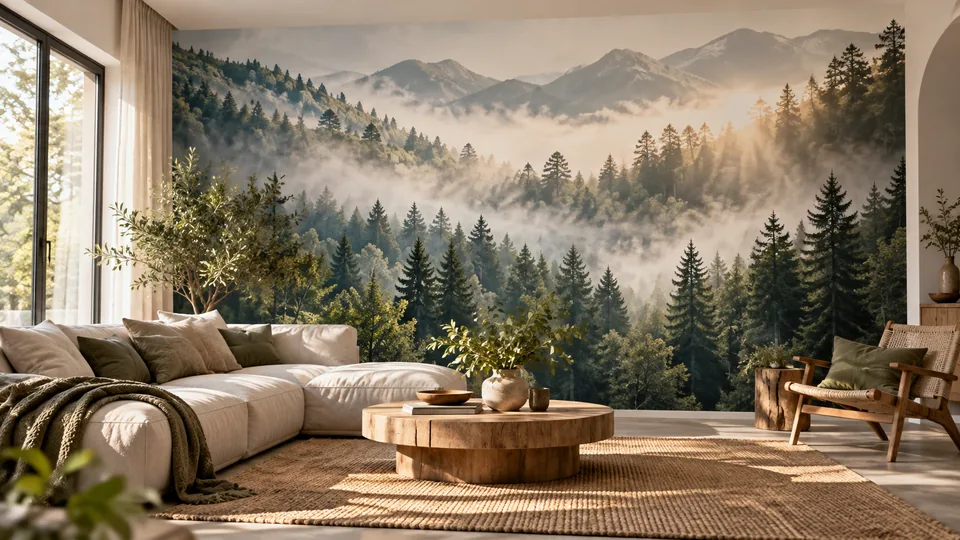
Nature wallpaper is the largest mural category: forests, mountains, seascapes, botanical leaves and skies. Landscape mural wallpaper and scenic wallpaper add depth to small rooms because the horizon line pulls the eye outward. Vintage landscape mural wallpaper in muted, painterly tones suits dining rooms and hallways, while scenic winter wallpaper and misty forests work well in calm bedrooms. Our green bamboo forest nature wallpaper is a typical example, supplied in 0.61 m × 3 m self-adhesive PVC rolls.
Modern, abstract and contemporary murals
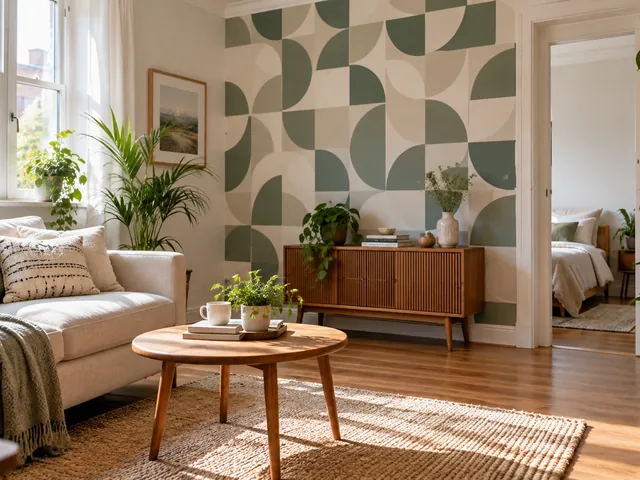
Modern wall art in mural form means large color fields, brush-stroke abstracts, geometric arches and line drawings. These read as contemporary wall decor and large contemporary wall art without the clutter of several frames, and large colorful wall art in this style is popular in offices, lounges and creative studios.
Ceiling murals
Ceiling mural wallpaper, usually sky and clouds or stars, turns the fifth wall into a feature. Self-adhesive film is easier overhead than pasted paper because it grabs instantly. See our blue sky and cloud ceiling mural wallpaper, made from waterproof, moisture-proof and mould-proof PVC.
3D and dimensional wall art
Three d wall art comes in two forms: printed murals with a trompe-l'oeil effect, and embossed or foam panels with real relief. Dimensional wall art and wood panel wall art add shadow lines that flat prints cannot. Our guide to 3D wallpaper and 3D foam wall panels covers the differences.
Kids and nursery murals
For children's rooms, a full mural is often combined with wall art for nursery stickers such as animals, stars or growth charts. Nursery wall art decals are easy to reposition as a child grows; check that the film is low-odor and wipe-clean.
Wall mural ideas by room
- Bedroom mural ideas: put the mural behind the headboard so it acts as wall art over the bed. Soft landscapes, florals and large abstract artwork in muted tones are the safest bedroom wall art ideas and bedroom wall artwork choices, and adult bedroom wall art tends toward dark botanicals or moody skies.
- Living room wall murals: choose one wall, usually the one you face from the sofa. A wallpaper mural for the living room can be scenic or architectural; keep TV walls simple so the screen does not compete.
- Dining room mural wallpaper: chinoiserie, vintage landscapes and large florals have a long tradition here and look good under warm light.
- Bathroom wall murals stickers and bathroom wall art stickers: use waterproof PVC film, keep it out of direct shower spray, and seal the bottom edge near basins.
- Kitchen wall art stickers: oil-proof, wipe-clean film is essential near the cooker; murals work best on a breakfast-nook or pantry wall.
- Office wall art stickers and wall wraps: brand colors, city skylines or line art on a reception or meeting-room wall, often paired with smaller contemporary wall accents.
Are peel and stick wall murals worth it? Materials compared
A good peel and stick wall mural lasts for years and removes cleanly; a poor one stretches, shows seams and lifts at the corners. The difference is mostly material, thickness and adhesive.
| Material | Typical thickness | Water resistance | Notes |
|---|---|---|---|
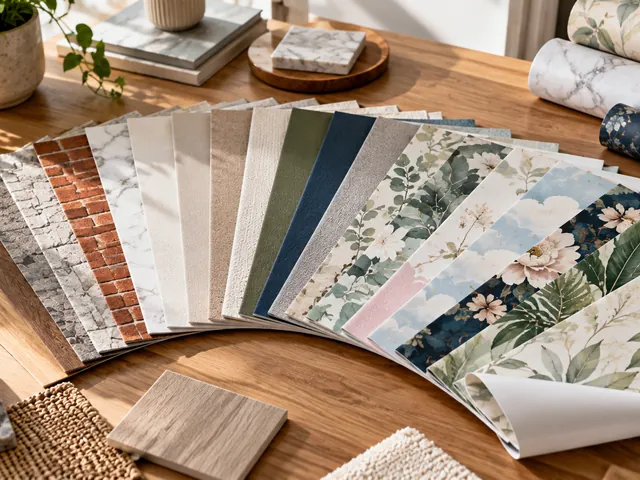
| PVC (vinyl) film | 0.1–0.3 mm (4–12 mil) | High, wipe-clean | Most common for self-adhesive murals; holds sharp print |
| Embossed PVC | 0.2–0.4 mm | High | Texture hides minor wall flaws and seams |
| Non-woven paper | 0.15–0.3 mm | Low to medium | Usually pasted; breathable, matte look |
| Fabric (polyester) with PSA | 0.2–0.35 mm | Medium | Repositionable; canvas-like texture |
Removable wall murals are only as good as their film. Cheap peel and stick wall murals are usually very thin film that telegraphs every bump in the wall and can stretch during installation, which distorts the image across seams. For best results, look for an opaque white base layer, a removable acrylic adhesive and a printed overlap of 1–2 cm (about 0.5 in) on each panel. Our ceiling sticker range, for example, is listed at 0.26 mm in 1.2 m × 50 m rolls.
Whatever the room, sketch the mural design on the wall first with painter's tape so you can judge the scale, the horizon height and where furniture will cover the image.
How do you measure and install a large wall mural?
Large wall murals and huge wall murals need careful planning because the image only aligns in one sequence. Allow 5 cm (2 in) of extra image on every edge for trimming.
- Measure the wall. Record width and height at three points and use the largest figures. Add 10 cm (4 in) to each dimension for bleed.
- Prepare the surface. Fill holes, sand smooth, and clean with mild detergent. Fresh paint needs 2–4 weeks to cure before any self-adhesive film goes on.
- Lay out the panels. Unroll and number them left to right on the floor, checking that the image runs correctly across each join.
- Mark a plumb line. Draw a vertical line with a level one panel-width (minus the overlap) from the starting corner; walls are rarely square.
- Hang the first panel. Peel 20–30 cm (8–12 in) of liner, align the edge to the line, then pull the liner down while smoothing from the center outward with a felt squeegee.
- Match and overlap. Align the next panel's image with the first, overlapping by the printed margin, and continue across the wall.
- Trim and finish. Cut the excess at the ceiling, skirting and sockets with a sharp blade and a straightedge, changing blades often.
Work at room temperature, ideally 18–25 °C (65–77 °F). For more detail on smoothing and seams, see how to install peel-and-stick wallpaper.
Custom wall murals: how do you order one printed to size?
Custom wall murals let you use your own photograph, artwork or brand image, printed exactly to the wall. Custom wall murals peel and stick are now common, and print on demand wallpaper services handle single rooms. What matters is the file:
- Resolution: aim for 100–150 dpi at final printed size. A 3 m (118 in) wide mural at 100 dpi needs an image about 11,800 pixels wide.
- Bleed: add 5 cm per side so trimming does not cut into faces or text.
- Color: supply files in CMYK or a wide-gamut RGB profile and request a printed strike-off before full production.
- Panel split: confirm the panel width (commonly 0.61 m or 1.22 m) and keep key details away from seams.
Wall photographs from phones are often too small for a full wall; landscapes and textures upscale better than portraits. For private-label and project volumes, see custom printed self-adhesive film from a factory.
Buying wall murals for retail, hotels and design projects
For retailers and e-commerce sellers, murals for the home sell best as a small, curated range: two or three nature designs, one abstract, one ceiling sky and one kids' theme, each in a standard retail roll. Hotels and restaurants usually need artistic wall murals in larger trade formats with fire-retardant or mould-proof grades confirmed by test reports.
As a manufacturer we supply self-adhesive wallpaper and mural films in 0.61 m × 3 m retail rolls and 0.61 m or 1.22 m × 50 m trade rolls. MOQ is 1 roll for stock items and 100 rolls for customized production, with lead times of 7–10 days for stock and 15–25 days for custom orders.
Next step
Send us your wall dimensions, the design or image you want, the room type and your expected quantity, and we will reply with a quotation within 24 hours. Free A4 samples are available so you can check print quality and adhesion on your own wall first; contact us here.
Frequently Asked Questions
Are peel and stick wall murals removable?
Yes. Most peel and stick wall murals use a removable acrylic pressure-sensitive adhesive that peels off sound, fully cured painted walls without residue. Pull slowly at a low angle, close to the wall. Removal problems usually come from fresh paint, flat or chalky paint, or murals left in hot sun, which can let the adhesive bond more strongly over time.
What is the best material for peel and stick wall murals?
For most rooms the best peel and stick wall murals are printed on PVC (vinyl) film about 0.1–0.3 mm thick with an opaque base and removable adhesive. PVC is waterproof and wipe-clean and holds sharp print detail. Embossed PVC hides wall flaws better, while fabric murals give a softer, canvas-like look but resist moisture less.
How big should a wall mural be?
A wall mural should cover the full wall it is designed for, plus about 5 cm (2 in) of bleed on every edge for trimming. Most residential feature walls are 2.4–2.7 m (8–9 ft) high and 2–4 m (6.5–13 ft) wide. Measure at three points, use the largest figure and order the image to that size.
Can you put a wall mural in a bathroom?
Yes, if you use waterproof PVC mural film and keep it out of direct shower spray. A bathroom with an extractor fan and painted, sealed walls suits self-adhesive murals well. Seal edges near basins and baths, avoid tiled grout lines, and choose a mould-proof grade where the room stays humid for long periods.
Is a wall mural cheaper than canvas wall art?
For covering a whole wall, usually yes. A peel and stick mural for a 3 m wall typically costs less than one extra large canvas print of 1.5 m, because film is printed on rolls while canvas needs stretching and framing. Canvas wall art is better when you want a single movable piece.
Can you put mural wallpaper on a ceiling?
Yes. Ceiling mural wallpaper with sky, cloud or star designs is popular in bedrooms and nurseries. Self-adhesive film is easier overhead than pasted paper because it grips immediately. Work with two people, use short panels, and start from the center line of the room so the design looks balanced from the doorway.
How do I make a custom wall mural from my own photo?
Measure the wall, add 5 cm of bleed per side, and check that your photo reaches 100–150 dpi at that size. A 3 m wide mural needs roughly 11,800 pixels across at 100 dpi. Send the file to a mural printer, approve a printed proof, and keep faces and text away from panel seams.