Key takeaways
- A pressure-sensitive adhesive (PSA) bonds on contact under light pressure, without heat, water or solvent, because it is a permanently tacky viscoelastic solid.
- Acrylic PSAs resist UV, heat and aging best and suit long-term indoor and outdoor films, while natural rubber PSAs give higher initial tack and lower cost but age faster.
- PSA bond strength builds over time as the adhesive flows into the surface, typically reaching full strength 24–72 hours after application at room temperature.
- Surface energy decides how well a PSA wets a material: glass, metal and painted surfaces bond easily, while low-energy plastics such as polyethylene and polypropylene need special adhesives.
- Permanent and removable PSAs differ mainly in peel strength and how much they build over time, so the same film can be specified with either adhesive for different jobs.
A PSA adhesive, short for pressure-sensitive adhesive, is a permanently tacky adhesive that bonds to a surface when you press it, without heat, water or solvent evaporation. It is the sticky layer on self-adhesive vinyl, peel-and-stick wallpaper, tapes, labels and protective films, and its chemistry, usually acrylic, rubber or silicone, decides how strong, clear and removable the bond is.
This guide explains how PSA bonding works, compares the main adhesive families and coating methods, and shows how to choose a self adhesive film for glass, walls, countertops, bathroom tiles and plastics. It ends with a checklist for buyers specifying adhesives on custom film orders.
What is a PSA adhesive?
You will also see it called PSA glue, PS adhesive or simply tacky adhesive, and a sheet coated with it is sometimes sold as tacky paper. Most glues are liquids that harden: they wet the surface, then dry or cure into a rigid solid. A PSA never hardens. It is a soft, viscoelastic polymer that behaves partly like a thick liquid and partly like an elastic solid at room temperature. That combination gives it three measurable properties:
- Tack: how quickly it grabs a surface with light contact. Often tested with a loop of tape touched to a steel plate.
- Peel adhesion: the force to pull the film off at an angle, typically 180°, usually reported in newtons per 25 mm (N/25 mm) of width.
- Shear strength: how long it holds a load parallel to the surface without sliding, which matters for vertical walls and heavy films.
A useful rule of thumb in adhesive science, the Dahlquist criterion, says a material is tacky when its stiffness (storage modulus) at room temperature is below about 0.3 MPa. Formulators tune polymers, tackifying resins and crosslinking to sit in that soft window while still resisting creep.
How does PSA bonding work?
PSA bonding is a physical process, not a chemical reaction. When you press a self-adhesive film onto a surface, the soft adhesive flows into microscopic peaks and valleys and comes into molecular contact. Weak van der Waals forces across millions of contact points add up to a strong bond.
- Pressure matters: firm squeegee or roller pressure increases contact area immediately.
- Time matters: the adhesive keeps flowing after application, so peel strength typically builds for 24–72 hours. This is called dwell time.
- Temperature matters: below about 10 °C (50 °F) most PSAs stiffen and lose tack; most films are applied at 15–30 °C (60–85 °F).
- Surface energy matters: the adhesive must wet the surface. High-energy surfaces such as glass, metal and ceramic bond easily; low-energy plastics resist wetting.
- Cleanliness matters: dust, grease, silicone polish and moisture sit between adhesive and surface and block contact.
Acrylic vs rubber vs silicone PSA
Three polymer families cover almost every PSA on the market.
| Property | Acrylic PSA | Rubber PSA (natural or synthetic) | Silicone PSA |
|---|---|---|---|
| Initial tack | Moderate, builds over time | High, instant grab | Moderate |
| UV and aging resistance | Excellent; stays clear | Poor to fair; can yellow and harden | Excellent |
| Temperature range (typical) | About −40 to 90 °C | About −20 to 65 °C | About −60 to 200 °C+ |
| Bond to low-energy plastics | Fair; special grades better | Good | Good, including silicone surfaces |
| Clarity | Water-clear | Often amber or opaque | Clear |
| Relative cost | Medium | Low | High |
| Typical uses | Wallpaper, decorative film, signage vinyl, window film, TPU protection film | Masking tape, sandblast stencil, packaging tape, short-term labels | High-temperature masking, medical, electronics |
Acrylic is the default for decorative self-adhesive film because it is clear, does not yellow and keeps its properties for years. Our TPU surface protection film, for example, uses a removable acrylic adhesive designed to stay on furniture for years and peel cleanly. Natural rubber adhesive is preferred where high grab and a clean, short-term hold matter, such as the pressure-sensitive rubber adhesive on our sandblast stencil film, which must grip stone under abrasive blasting.
Solvent-based vs water-based vs hot-melt PSA
The same polymer can be coated onto film in different ways, and the coating method changes performance.
- Solvent-based acrylic: polymer dissolved in organic solvent, coated and dried. It gives the best water resistance, clarity and high-temperature performance, and is used for premium signage vinyl, window film and outdoor graphics. Solvent is recovered or incinerated at the factory.
- Water-based (emulsion) acrylic: polymer dispersed in water. Lower emissions and cost; widely used in labels, wallpaper and indoor decorative film. Early grades whitened slightly when wet, though modern formulations have improved water resistance.
- Hot-melt: usually synthetic rubber blended with resins and applied molten with no solvent or water. High tack and fast production, common for packaging tape and labels, but softens at higher temperatures.
- UV-cured: liquid acrylic cured by UV light, used for specialty and thick adhesive layers.
How is the adhesive coating applied?
In a factory, adhesive coating is a continuous roll-to-roll process. The PSA is usually coated onto the silicone release liner first, dried or cured in a long oven, then laminated to the face film and wound into an adhesive roll. This transfer method keeps solvent and heat away from heat-sensitive face films and gives an even coat weight across the width. The finished adhesive film roll is then slit to standard widths such as 0.61 m and 1.22 m.
For buyers, the practical question is less about chemistry and more about the test result: ask for peel adhesion, shear and aging data on the substrate you will use.
Permanent vs removable vs repositionable adhesive
Adhesive grades are defined by how they behave over time on the surface.
| Grade | Behavior | Typical uses |
|---|---|---|
| Permanent | High peel strength that builds over days; removal may leave residue or damage the surface | Outdoor signs, vehicle graphics, equipment labels, furniture film |
| Removable | Moderate peel strength that stays low over time; peels cleanly within its rated period | Wall decals, temporary signs, rental wallpaper, protection film |
| Repositionable | Low initial tack or air-release channels so the film can be lifted and moved during installation | Large wallpaper panels, wall murals, beginner-friendly vinyl |
| Ultra-removable / low-tack | Very low peel; for delicate surfaces | Transfer tape, paint masking, screen protection |
The same face film can be supplied with either adhesive. Our cutting vinyl, for example, comes in permanent and removable versions; see the permanent vs removable cutting vinyl guide for when to use each.
How is self-adhesive film constructed?
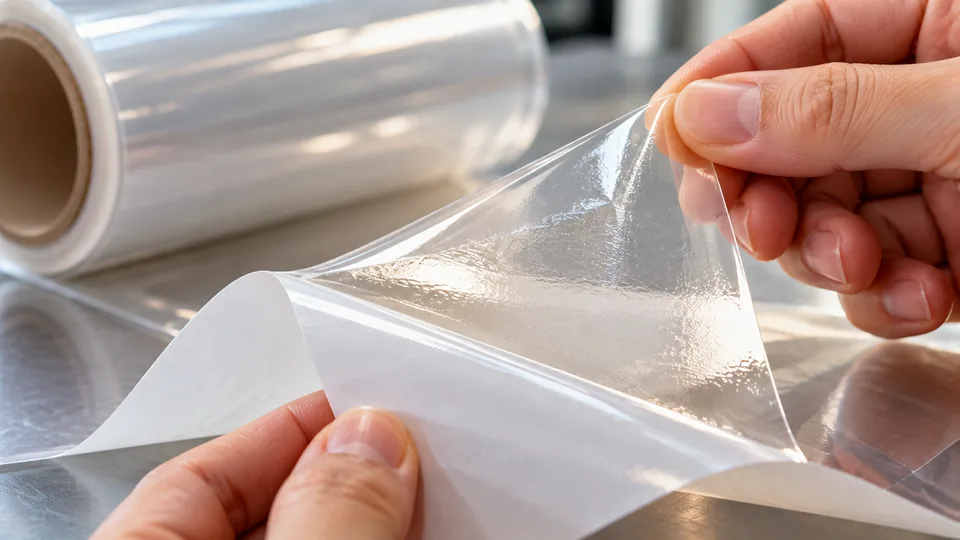
Almost every self adhesive film, from adhesive sheets for printers to decorative furniture wrap, follows the same layered build:
- Face film: PVC, PET, TPU, PE or paper, carrying the color, print or texture.
- Primer (optional): a tie layer that anchors the adhesive to the face film so it does not transfer to the wall on removal.
- PSA layer: typically 15–40 micron thick, or a coat weight of roughly 15–40 g/m².
- Release liner: silicone-coated paper or PET film that protects the adhesive until use. Some liners are printed with a grid for cutting.
Our plotter-cut graphic and signage vinyl uses this three-layer construction of vinyl film, adhesive and release liner in 80–200 micron face thicknesses. Adhesive printer paper and print-on adhesive sheets use the same idea with a printable paper or film face, and clear adhesive sheets or self adhesive sheets for crafts use a transparent PET or PVC face. An adhesive stencil, such as sandblast resist or paint masking film, uses a thicker face and a rubber or low-tack acrylic adhesive so it can be weeded and removed cleanly.
Which adhesive film works on which surface?
- Adhesive on glass: glass is high-energy and smooth, so acrylic PSAs bond very well. Clear self adhesive film and frosted window film often use a wet application to allow positioning.
- Painted walls: bond depends on the paint. Fresh paint needs 2–3 weeks to cure; matte and low-VOC paints may give lower adhesion, so test a sample first.
- Adhesive bathroom tiles and self adhesive vinyl tiles: need a moisture-resistant acrylic and a clean, degreased, dry surface; avoid areas under constant water spray. The best adhesive tiles for a self adhesive bathroom makeover have a thicker adhesive layer to bridge minor unevenness. Bathroom adhesive stickers and other bathroom decoration adhesive products follow the same rules.
- Adhesive kitchen countertop covering: a heat- and grease-resistant decorative adhesive film over sound laminate, kept away from hot pans. Any adhesive countertop covering should be tested near the sink, where water attacks the edges first.
- Self adhesive protective film: clear TPU or PE adhesive protective film uses a removable acrylic or low-tack rubber PSA so it can stay on furniture, glass or metal and peel off without residue.
- Adhesive stone and stone adhesive tiles: porous stone may need sealing first; rubber adhesives grip rough stone better for temporary masking.
- Low-energy plastics (PE, PP): adhesive plastic bonding is the hardest case, because standard acrylic struggles; rubber-based or modified acrylic adhesives, or surface treatment, are needed.
- Shelves and drawers: adhesive shelf paper stays put; non adhesive shelving paper relies on a grip texture and lifts out for cleaning.
How to clean off adhesive residue
Knowing how to clean off adhesive is part of choosing it: removable grades are designed to leave nothing behind, but any PSA can leave residue if conditions are wrong.
When a PSA is removed too fast, too cold or after its rated life, some adhesive can stay behind. The general method is to soften it, lift it and dissolve the remainder:
- Warm the film or residue with a hairdryer and peel slowly at a low angle, close to 180°.
- Roll leftover adhesive off with your thumb or a rubber eraser.
- Dissolve the rest with isopropyl alcohol on glass and metal, or a citrus-based remover on painted and sealed surfaces, testing in a hidden spot first.
- Wash with warm soapy water to remove any oily film before applying a new adhesive.
Our complete guide on how to remove sticker residue covers each surface in detail.
Specifying adhesive on custom film orders
For distributors, sign shops and private-label sellers, the adhesive is as important as the face film. When you request quotations, state:
- The substrate and surface condition, such as painted drywall, glass, laminate, stainless steel or stone.
- Permanent, removable or repositionable, and the expected service life.
- Indoor or outdoor use and the temperature range.
- Liner type (paper or PET) and whether you need a grid or air-release channels.
- The test you will use to approve samples, for example peel after 24 hours at room temperature.
Stock films ship from 1 roll in 7–10 days; customized adhesive, liner and packaging combinations start at 100 rolls with 15–25 days lead time.
Next step
Tell us the film type, the surface it must stick to, whether it needs to be removable and the expected volume, and we will suggest an adhesive grade. Free A4 samples let you run your own peel and removal tests. Request samples or a quotation through our contact page.
Frequently Asked Questions
What does PSA mean in adhesives?
PSA stands for pressure-sensitive adhesive, an adhesive that stays permanently tacky and bonds when pressed onto a surface, without heat, water or solvent. It is used on tapes, labels, self-adhesive vinyl, peel-and-stick wallpaper and protective films. The most common PSA chemistries are acrylic, natural or synthetic rubber, and silicone.
Is acrylic or rubber adhesive better?
Acrylic adhesive is better for long-term, clear and outdoor applications because it resists UV light, heat and aging and does not yellow. Rubber adhesive gives higher initial tack and costs less, and it grips low-energy plastics and rough surfaces well, but it ages faster. Choose by service life, surface and temperature.
How long does pressure-sensitive adhesive take to bond?
A pressure-sensitive adhesive bonds instantly on contact, but it keeps flowing into the surface afterward, so peel strength typically builds for 24 to 72 hours at room temperature. Firm pressure during application and temperatures between about 15 and 30 degrees Celsius speed this up. Avoid heavy loads or wet cleaning during that period.
Why does self adhesive film not stick?
Self-adhesive film usually fails to stick because the surface is dusty, greasy, damp, too cold or freshly painted, or because it is a low-energy plastic such as polyethylene. Clean with isopropyl alcohol, let the surface dry, work above about 15 degrees Celsius and press firmly with a squeegee. Test a sample on uncertain surfaces.
What is the difference between permanent and removable adhesive?
Permanent adhesive has high peel strength that builds over time and is meant to stay for years; removing it may leave residue. Removable adhesive has lower peel strength that stays stable, so it peels cleanly within its rated period. The face film can be identical; only the adhesive grade and its long-term behavior differ.
How do you clean off adhesive residue?
Warm the residue with a hairdryer, then roll it off with your thumb or a rubber eraser. Dissolve what remains with isopropyl alcohol on glass and metal, or a citrus-based remover on painted or sealed surfaces, after testing in a hidden spot. Finish by washing with warm soapy water to remove any oily film.
Does PSA adhesive work on glass?
Yes. Glass has high surface energy and a smooth finish, so pressure-sensitive acrylic adhesives bond to it very well. Clean the glass thoroughly, and for window films use a wet application with a slip solution so the film can be positioned and squeegeed free of bubbles. Bond strength builds over the following days.