Key takeaways
- Clear TPU countertop protection film blocks scratches, stains and acid etching across the whole surface but is not designed for hot pans.
- Quartz countertops are non-porous engineered stone and do not need sealing, but their resin can scorch under hot cookware.
- Marble etches on contact with acids such as lemon juice and vinegar, and only a physical barrier such as film prevents it.
- Food-grade silicone counter mats typically tolerate around 230 °C (450 °F), making them the simplest local heat protection.
- An 8.5 mil TPU film of about 215 micron is the usual grade for kitchen countertops and other horizontal work surfaces.
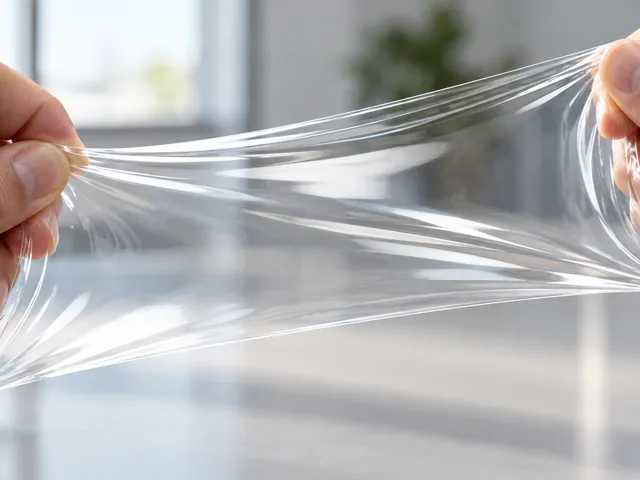
Countertop protection film is an optically clear, self-adhesive film, usually TPU, applied over quartz, marble, granite or wood to block scratches, stains and etching while keeping the surface visible. Compared with silicone mats, glass tops and sealers, film gives invisible, full-surface protection that removes cleanly, but it is not heat-proof, so hot pans still need a trivet.
Kitchen counters, dining tables and desks are some of the most expensive surfaces in a home, and a single lemon spill on marble or a dragged cast-iron pan on quartz can leave a permanent mark. This guide compares the four main ways to protect them, explains which option suits which material, and shows how to install a clear countertop protector film properly.
Countertop protection options compared
There is no single best countertop protector; each method solves a different problem. The table compares typical performance.
| Option | Visibility of original surface | Scratch and stain protection | Heat protection | Coverage | Typical life |
|---|---|---|---|---|---|
| Clear TPU protection film | Nearly invisible, glossy or matte | High; self-healing top coat | Low; not for hot pans | Full surface, edge to edge | 5+ years |
| PVC clear film or vinyl table cover | Clear, slight haze | Medium; scratches permanently | Low | Full surface | 1–3 years; can yellow |
| Silicone counter mat | Covers the area under the mat | High, locally | High; typically to about 230 °C (450 °F) | Work zone only | Several years |
| Glass top | Visible but adds reflections and edges | High; can chip | Medium | Tables and desks; rarely full counters | Permanent |
| Stone sealer | Invisible | Stains only; no scratch protection | None | Full surface | Re-apply every 1–3 years |
Many kitchens combine methods: a sealer or film for the whole surface, plus a heat resistant mat for the countertop zone beside the stove.
What is countertop protection film made of?
Most premium countertop film is thermoplastic polyurethane (TPU), the same material family used for automotive paint protection film. A typical construction has four layers: a PET release liner, a removable acrylic pressure-sensitive adhesive, a TPU base film and a self-healing top coat. Light scratches in the top coat close on their own at room temperature, faster with warm water.
Thickness is quoted in mil (1 mil = 25.4 micron). For horizontal work surfaces, thicker film absorbs more impact:
- 6.5 mil (about 165 micron): most flexible; for cabinet doors, curved edges and furniture.
- 7.5 mil (about 190 micron): dining tables, desks and sideboards.
- 8.5 mil (about 215 micron): kitchen countertops, kitchen islands, bar tops and reception counters.
Our clear TPU furniture protection film comes in all three grades on 1.52 m × 15 m (about 60 in × 49 ft) rolls, wide enough for most countertop runs without a seam. For the science of self-healing and anti-yellowing, read TPU surface protection film explained.
How to protect quartz countertops
Quartz countertops are engineered stone, roughly 90% ground quartz bound with polymer resin. They are non-porous, so they do not need a quartz countertop sealer, and products sold as sealant for quartz countertops add little. The real risks are different:
- Heat: the resin can scorch or discolor under a hot pan. Use trivets or heat resistant mats for quartz countertops near the hob.
- Chemicals: strong alkaline or solvent cleaners can dull the resin finish.
- Impact and scratches: dropped cookware can chip edges, and ceramic bases leave fine marks on polished quartz.
Quartz countertop protection film addresses scratches, stains and chips across the whole surface, while a silicone countertop protector handles heat locally. That combination is the most complete answer to how to protect quartz countertops in a busy kitchen.
How to protect marble and granite countertops
Natural stone behaves differently from quartz because it is porous.
Marble: sealer plus film
Marble is mainly calcium carbonate, so acids such as lemon juice, wine and vinegar etch it, leaving dull spots that no sealer prevents. A marble stone sealer reduces staining from oil and coffee by filling pores, but it does not stop etching or scratches. Marble protection film is the only option that blocks acid contact entirely, which is why it is popular on marble kitchen islands and dining tables. A high quality marble sealer is still worth applying first on unsealed stone.
Granite: penetrating sealer, then optional film
Granite is harder and resists acids better than marble, but many granites are porous. A penetrating granite sealer soaks into the stone and is typically reapplied every one to three years; test by dripping water on the surface: if it darkens the stone within a few minutes, it is time to reseal. Granite benchtop protection film adds scratch and impact protection on heavily used counters, and it can also be used when wrapping granite countertops during renovation work.
Silicone mats for countertops: when they make sense
Silicone mats for countertops are the simplest heat protection. Food-grade silicone kitchen counter mats typically tolerate around 230 °C (450 °F) and are non-slip, waterproof and easy to wash. They work well as:
- A heat resistant kitchen counter mat beside the stove or under an air fryer or coffee machine.
- A countertop mat for baking and kneading dough.
- A kitchen counter protector mat under small appliances that vibrate or scratch.
Their limitation is coverage: a mat protects only the area it covers, hides the countertop you paid for, and can trap moisture underneath if not lifted and dried. For full-surface, invisible protection, film is the better choice; for heat, a mat is.
Clear table protector: film vs glass vs plastic covers
For dining tables and desks, the choice is usually between a glass top, a plastic table cover protector such as a clear vinyl tablecloth, and a clear protective film.
- Glass tops, typically 4–6 mm (about 3/16–1/4 in), are durable but heavy, reflect light, chip at edges and can trap moisture.
- Clear vinyl tablecloths and loose PVC covers are cheap and removable but look plastic, slide around and yellow.
- TPU film bonds directly to the surface, is barely visible, and follows edges. It is the best clear table protector for permanent pieces and for rental and hospitality furniture.
See how furniture makers and showrooms use it in our furniture protection case study.
How do you install countertop protection film?
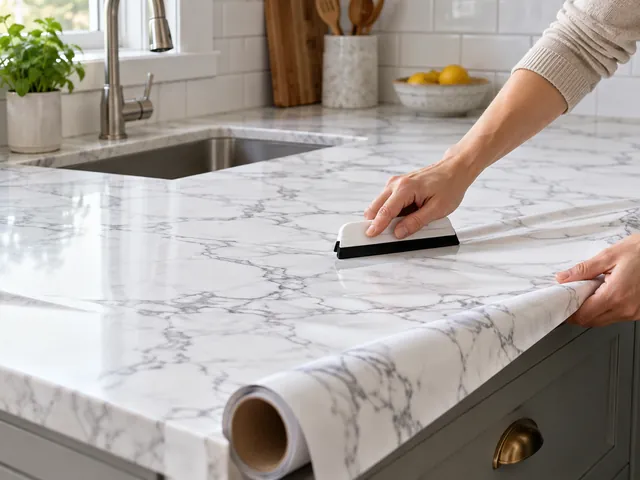
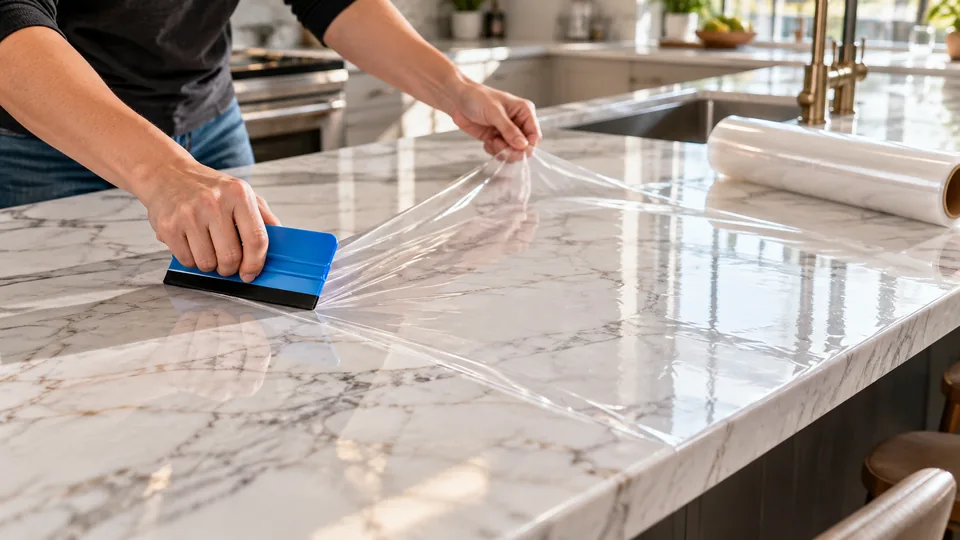
Surface protection film installation on a countertop is a wet-application job. Allow one to two hours for an average kitchen run, and work at 15–30 °C (59–86 °F).
- Clean and degrease. Wash the counter, then wipe with isopropyl alcohol to remove silicone polish, oil and residue. Any trace of polish is the main cause of edge lifting.
- Measure and rough-cut. Cut the film about 3–5 cm (1–2 in) larger than the surface on every side.
- Spray slip solution. Mist the countertop generously with water and a few drops of baby shampoo.
- Peel and wet the adhesive. Remove the liner while spraying the adhesive side so it does not stick to itself.
- Lay and position. Float the film onto the counter and slide it into place.
- Squeegee from the center. Use a felt-edged squeegee with firm, overlapping strokes to push out water and air.
- Heat and wrap edges. Warm the film at the edge with a heat gun at about 60–80 °C, wrap it over the edge profile and press down.
- Trim and cut openings. Trim excess with a sharp blade, and cut neatly around sinks, hobs and taps.
- Cure. Leave 24–48 hours before heavy use or wet cleaning; light haze clears as moisture evaporates.
Our countertop project shows the opaque decorative-film route on a laminate worktop.
What can and cannot go on a film-protected countertop?
Once cured, TPU film behaves like a tough, wipe-clean surface, but a few rules keep it looking new:
- Safe: plates, cups, glasses, laptops, spilled wine, coffee, oil, lemon juice and vinegar. Liquids bead on the hydrophobic top coat and wipe away.
- Use a board: knives. A sharp blade cuts through any film, so always chop on a cutting board.
- Use a trivet or mat: pans, kettles and baking trays straight from the heat, and countertop appliances that run hot underneath. Heat can cloud or distort the film and soften the adhesive.
- Clean gently: mild dish soap or a neutral cleaner with a soft cloth. Avoid abrasive pads, scouring powders and strong solvents such as acetone.
- Check edges: around sinks, press down any edge that lifts and keep standing water from sitting along seams.
Treated this way, the film can stay in place for years and still peel off to reveal the original stone or wood in the condition it was in on installation day. That is the key reason property managers and furniture retailers specify it for high-value surfaces.
Protection film vs countertop vinyl and contact paper
Clear protection film and countertop vinyl are often confused. Peel and stick countertop covering and countertop sticker paper are opaque decorative films, usually marble or wood-printed PVC, that change the look of a worn counter. Clear TPU film keeps the existing look and protects it. If your aim is a new appearance, read contact paper and vinyl wrap for countertops instead.
For installers, retailers and furniture makers, our TPU protection film range includes glossy and matte grades with more than 5 years of warranty, MOQ from 1 roll and stock lead times of 7–10 days.
Next step
Tell us the surfaces you need to protect, the finish (glossy or matte), thickness and roll quantity, and we will send a quotation within 24 hours. Contact us for free A4 samples to test clarity and adhesion on your own countertop.
Frequently Asked Questions
Does countertop protection film really work?
Yes. Clear TPU countertop protection film effectively blocks scratches, stains, chips and acid etching because spills and impacts land on the film instead of the stone or wood. Its self-healing top coat hides light scratches over time. It does not protect against heat, so hot pans should always go on a trivet or silicone mat.
How do you protect quartz countertops from heat?
Use trivets, silicone mats or heat resistant pads under hot pans, slow cookers and air fryers. Quartz is bound with polymer resin, which can scorch or discolor under high heat even though the stone itself is hard. Protection film shields quartz from scratches and stains, but it is not a heat barrier.
Do quartz countertops need to be sealed?
No. Quartz countertops are engineered stone made of ground quartz and resin, so they are non-porous and do not absorb liquids. Sealers marketed for quartz add little benefit. Clean quartz with mild soap and water, avoid harsh alkaline cleaners, and use film or mats if you want extra protection against scratches and heat.
What is the best clear table protector?
For permanent furniture, a clear TPU protection film is usually the best clear table protector because it bonds directly to the surface, is almost invisible, follows the edges and self-heals light scratches. Glass tops are durable but heavy and reflective, while clear vinyl tablecloths are cheap but look plastic and tend to yellow.
Can protection film be removed from marble without damage?
Yes, quality TPU protection film uses a removable acrylic adhesive designed to peel cleanly from sealed marble, granite, quartz and finished wood. Warm the film gently with a hairdryer and peel slowly at a low angle. Any faint adhesive residue can be wiped off with a mild soap solution or isopropyl alcohol.
Are silicone mats good for countertops?
Silicone mats are good for countertops where you need heat protection or a non-slip work area, such as beside the stove or under small appliances. Food-grade silicone typically tolerates around 230 °C. They only protect the area they cover, and moisture can collect underneath, so lift and dry them regularly.
How often should you seal granite countertops?
Most granite countertops need a penetrating sealer every one to three years, depending on the stone's porosity and how heavily the counter is used. To test, drip water on the surface: if the stone darkens within a few minutes, reseal. Dense, dark granites may need sealing less often than light, porous ones.